Language Access and Cultural Competence: A Shared Responsibility in Healthcare
Language access and cultural competence work together. Providers and Interpreters build trust, recognize context and help every patient understand and participate in care.
For Care Culture Talks, I sat down with Dr. Stevenson Chery, a physician and Haitian-American healthcare leader who has spent his career at the point where language, culture and medicine meet. Born in Haiti and raised in the United States from the age of 13, Dr. Chery experienced what it means to navigate a new country and a new clinical system at the same time.
Expert insights on Culturally Competent Care
Language access and cultural competence are both essential to equitable healthcare. Skilled interpreters bring linguistic expertise, cultural insight and contextual understanding to the clinical encounter. Providers bring clinical judgment, relationship-building and responsibility for making sure patients understand their care plans. When interpreters and providers work together (and receive the training and support they need) communication becomes more than an exchange of words. It becomes a foundation for trust, understanding and better care.
Culturally competent care is a shared practice. Interpreters contribute language and cultural expertise, providers contribute clinical and relational expertise and healthcare organizations are responsible for creating the training, workflows and technology that allow both to succeed.
This shared responsibility matters for every health system, clinic, telehealth organization and access center serving patients who speak a language other than English. Language access makes communication possible. Cultural competence helps make that communication trusted, understood and usable.
What is Culturally Competent Care in Healthcare?
Culturally competent care is care adapted to a patient’s language, cultural context, beliefs, communication norms and health-literacy needs. A medical interpreter enables communication across languages but the provider must still build trust, recognize relevant cues, ask rather than assume and confirm that the patient understands the care plan.
Cultural competence is not a memorized list of behaviors for every nationality or language group. Patients are individuals and no cultural pattern applies to everyone. A responsible approach combines cultural knowledge with cultural humility: notice a possible cue, explore it respectfully and allow the patient to explain what matters to them.
How Language Access and Cultural Competence work together
Dr. Chery described how a Haitian Creole-speaking patient can leave a visit having agreed to everything while understanding very little. In some Haitian cultural and clinical contexts, patients may be accustomed to physicians being treated as authorities and may hesitate to challenge a recommendation or admit confusion.
That does not mean every Haitian patient communicates this way. It means a provider should not automatically interpret a nod, quietness or agreement as proof of understanding.
“It is beyond just having an interpreter or a language line.” Dr. Stevenson Chery
Interpreters are essential partners in this work. Accurate interpretation creates the conditions for trust, shared decision-making and comprehension, while providers remain responsible for the clinical relationship and for confirming that the care plan is understood. Both roles matter, and both benefit from clear training and collaborative workflows.
How providers can read Cultural Cues without Stereotyping
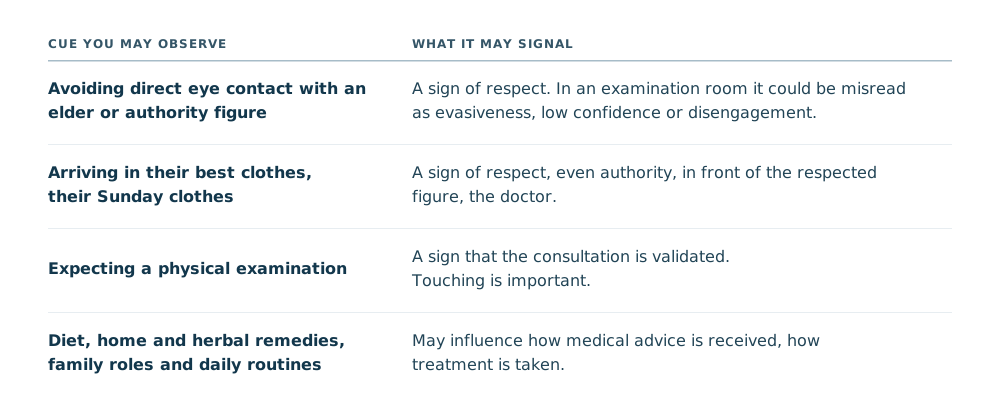
Some patients may avoid direct eye contact with an elder or authority figure as a sign of respect. In an examination room, that behavior could be misread as evasiveness, low confidence or disengagement. Some patients may arrive in their best clothes or expect a physical examination because being listened to and examined is part of how they understand attentive care. Diet, home remedies, family roles and daily routines may also influence how medical advice is received.
These examples are cues to explore, not assumptions to apply. A culturally responsive provider might ask, “How do you usually approach this at home?” or “What would make this plan easier for you to follow?” rather than assigning meaning to a behavior too quickly.
The same principle applies to every community. Culturally competent care means recognizing that the provider’s own communication norms are not universal and creating space for the patient to describe their perspective.
Culturally Competent Care in front of Haitian Patient Population
What is the difference between Cultural Competence and Cultural Humility?
Cultural competence often describes the knowledge and skills needed to provide respectful care across cultural contexts. Cultural humility adds an important discipline: recognizing that no provider can master every culture and that patients are often the best teachers of their own experiences.
In practice, cultural humility means asking rather than assuming, reflecting on one’s own biases and remaining open to correction. It protects cultural competence from becoming a checklist or a set of stereotypes.
“One of our biggest teachers is the patients.” Dr. Stevenson Chery
Dr. Chery treats patients as collaborators who can teach him how to care for them. That posture, more than any single technique, is what culturally responsive care looks like day to day.
Why Sensitive Topics require Cultural Patience
Mental health and sexual health for example are two areas where stigma, privacy concerns and family expectations can make communication especially difficult. A patient may respond defensively to a behavioral-health question or avoid discussing a sensitive symptom because of how the topic has been understood in their family or community. (This is also one of the reasons why regulations generally do not recommend using a family member as an interpreter, particularly in medical settings. Read more about the role of family members in medical interpreting here.)
The response should not be to label the patient as resistant. Providers can slow down, explain why a question matters, use nonjudgmental language and ask permission before moving deeper into a sensitive subject. Trust may take more than one visit to build.
Medical interpreting can help make the conversation accessible but the provider remains responsible for creating a setting where the patient feels safe enough to answer honestly.
How AI medical interpreting supports privacy in mental health
Medical interpreting can help make the conversation accessible but the provider has to remain responsible for creating a setting where the patient feels safe enough to answer honestly. Mental health is one area where AI interpreting can offer a distinct advantage over a human interpreter. With AI, there is no third person in the room, so a patient who feels ashamed or uncomfortable discussing intimate or sensitive matters may find it easier to open up when a tool, rather than another person, is relaying the conversation to the doctor. This insight comes from Dr. Lavin, a mental health expert who studies the impact of telemedicine on mental health care. Used well, technology becomes a bridge in culturally competent care.
How providers should work with a Medical Interpreter
The provider, patient and interpreter form a three-way clinical conversation. Cultural posture can change in how that conversation is managed and can improve clarity and trust.
Speak directly to the patient
Use first-person language and maintain attention on the patient rather than speaking to the interpreter (or tablet, or phone) as though the interpreter were the person receiving care. The interpreter is facilitating the conversation; the patient remains the center of it.
Dr. Chery described greeting patients in a way that reflects respect and comfort for them, including using a small bow rather than assuming a handshake is appropriate. The broader lesson is to ask or observe what helps the patient feel welcomed rather than imposing a standard interaction.
Watch for communication drift
If the patient’s response does not match the question, if the care plan is repeatedly misunderstood or if the emotional tone changes unexpectedly, pause and investigate. Providers should be willing to ask for clarification or request a different interpreting method if communication problems persist.
When possible, visual support can also help. No Barrier’s real-time retranscription for instance allows the provider and patient to read the conversation as it is spoken, giving both parties another way to notice possible omissions or misunderstandings.
The Provider’s Role in Leading Culturally Competent Care
Medical interpreting is a tool that supports communication; the provider remains responsible for leading the clinical encounter, setting the tone and guiding culturally competent care. As Dr. Sam Frenckel shared in an interview with Rivka Allouche, who creates language-access content at No Barrier, this principle applies whether interpretation is provided by a human interpreter during an inpatient visit, over the phone, by video or through an AI-assisted system. Interpreters should convey the provider’s meaning accurately and impartially without allowing personal emotions, beliefs or cultural views to influence the diagnosis or treatment discussion. At the same time, professional interpreters must be able to clarify ambiguity and raise communication concerns through the appropriate channel. For example, a reported case involving a religiously sensitive pregnancy decision highlights why providers must lead the clinical conversation clearly, while interpreters maintain accuracy, neutrality and professional boundaries.
How teach-back works in medical interpreting
Teach-back is a method for confirming understanding. Instead of asking, “Do you understand?” (a question that can produce an automatic yes) the provider asks the patient to explain the plan in their own words.
At the end of a visit, Dr. Chery asks patients to state the plan back to him: what the medication is for, how they should take it, what they need to do next and when they should follow up. If the response is inaccurate, the provider can clarify before the patient leaves.
A provider might say:
“I want to make sure I explained this clearly. Can you tell me how you will take this medicine when you get home?”
The responsibility belongs to the provider, not the patient. If the patient cannot explain the plan, that is a signal to review the explanation, interpretation, instructions or care context (not a reason to blame the patient).
Teach-back is useful with English-speaking patients too. Confirming understanding is good medicine in any language.
How technology can support interpreters and providers
Technology can reduce avoidable language friction and give the care team greater visibility into whether the conversation is being understood.
No Barrier is an AI-first medical interpreting platform that supports in-person visits, phone calls through call centers and video telehealth; all in one interface. Its real-time retranscription allows both the provider and patient to read the conversation as it happens. When the language layer is visible and consistent, the provider can focus more fully on the human work Dr. Chery describes: reading the room, building trust, asking better questions, and confirming that the message landed.
The technology supports the partnership; it does not replace the provider’s clinical judgment, the professional interpreter’s expertise, provider training or the patient’s voice. The technology only instantly interprets, allowing the provider to be in control.
Why reliable language access matters to health systems
Culturally competent care is built patient by patient, cue by cue and visit by visit. Reliable language access makes that work possible because providers cannot build understanding if patients and care teams lack a dependable way to communicate.
For health systems, this is also a workflow issue. Language access should be available when the provider or staff member needs it. The quality of the encounter depends not only on whether interpreting is technically available but also on whether the interaction allows enough time and attention for questions, clarification and teach-back.
No Barrier provides language access across 295+ language options, including Haitian Creole, through a flat monthly subscription rather than per-minute billing. This model is designed to reduce time pressure during sensitive conversations. No Barrier’s role is to help ensure that language is not the reason a patient leaves without understanding.
Culturally competent care adapts communication and care delivery to a patient’s language, cultural context, beliefs, communication norms and health-literacy needs. It includes building trust, asking rather than assuming, recognizing relevant cultural cues and confirming that the patient understands the care plan.
Is language access the same as culturally competent care?
No. Language access provides a reliable way for a provider and patient to communicate across languages. Culturally competent care is broader: it includes language access as well as cultural humility, trust-building, respectful communication and verification of understanding.
What is the difference between cultural competence and cultural humility?
Cultural competence refers to the knowledge and skills needed to care respectfully across cultural contexts. Cultural humility emphasizes lifelong learning, awareness of personal assumptions and willingness to let patients explain their own experiences rather than treating culture as a fixed checklist.
How can technology help keep medical interpreting culturally competent?
Medical interpreting technology should be a tool and a bridge between providers and patients, just like a human interpreter. The provider remains in control of the conversation. No Barrier’s AI medical interpreter is designed to provide neutral, accurate communication without adding emotion, opinions or personal bias.
Yes. Haitian Creole is one of No Barrier’s 295+ language access options. Our AI medical interpreting solution has received strong feedback from providers using it in real clinical settings, including here at CAN Community Health.
Eyal Heldenberg
Co-founder and CEO, building No Barrier
Eyal has 20+ years in speech-to-speech and voice AI and is the co-founder of No Barrier AI, a HIPAA-compliant medical interpreter platform. Over the past two years, he has led its adoption across healthcare organizations, helping providers bridge dialect gaps, reduce compliance risk and improve patient safety. His mission is simple: ensure health equity by removing language barriers at the point of care.









.svg)