Haitian Creole in U.S. Health Care: Strategic Imperatives & Risks
Haitian Creole is an advanced, context-driven language that makes certified medical interpreters scarce and AI translation uniquely challenging for U.S. healthcare systems.
According to Slator, Haitian Creole is spoken in “more than 1.1 million households” in the U.S., based on U.S. Census American Community Survey data.
In the state of Florida alone there are over 426,000 Haitian language speakers. (Axios)
Limited English proficiency among Haitian Creole speakers creates critical communication gaps, raising liability, safety and regulatory risks.
Investing in professional Creole interpretation, translated materials and cultural competence training drives efficiency, patient trust and outcomes, with ROI through reduced error, readmissions and legal exposure.
Health systems should embed Creole-language strategy in population health, equity, compliance and quality programs to serve a growing Haitian-American population.
Context & Significance
Demographics & Health Disparities
Haitian-Americans are one of the larger Black immigrant subpopulations in the U.S.; yet they are often subsumed under “African American” in data, masking unique needs. (Stanford Medicine)
They frequently face socioeconomic challenges, lower health literacy, insurance gaps and barriers to care. (Stanford Medicine)
Among Haitian immigrants, a substantial share report speaking English “less than very well,” increasing risk of miscommunication in medical settings.
Language & Cultural Dimensions
Haitian Creole (Kreyòl Ayisyen) is distinct from French; many Haitians (even those who read French) prefer or feel more comfortable communicating sensitive health issues in Creole. (Minnesota Department of Health)
Cultural beliefs, spiritual frameworks (including Vodou, traditional healing), views on illness and family decision patterns are important context for care. (Minnesota Department of Health)
Language is not merely a translation barrier; it is interwoven with identity, trust, power, and perceived dignity in care encounters. (Phoenix Files)
Risks & Liabilities of Inadequate Creole Access
Patient Safety & Quality Risk
Misdiagnoses, incorrect medication usage, consent forms misunderstood or follow-up instructions ignored are real threats when communication is flawed.
In scenarios like acute care, mental health or emergencies, the inability to understand or be understood can have severe clinical harm.
Compliance & Legal Exposure
Title VI of the Civil Rights Act requires nondiscrimination, including language access, in entities receiving federal funds (e.g. Medicare, Medicaid).
Obligations under state-level “Limited English Proficiency” (LEP) statutes or regulations may extend liability if a patient’s right to an interpreter is denied or delayed.
Informed consent in a language the patient understands is a legal standard; failure to do so can lead to malpractice or regulatory action.
Reputational, ROI and Operational Risk
Poor patient experience leads to poor retention, complaints, claims or adverse accreditation findings.
Ignoring a linguistic subpopulation may hinder equity metrics, value-based care goals and strategic growth into communities.
Strategic Framework & Best Practices
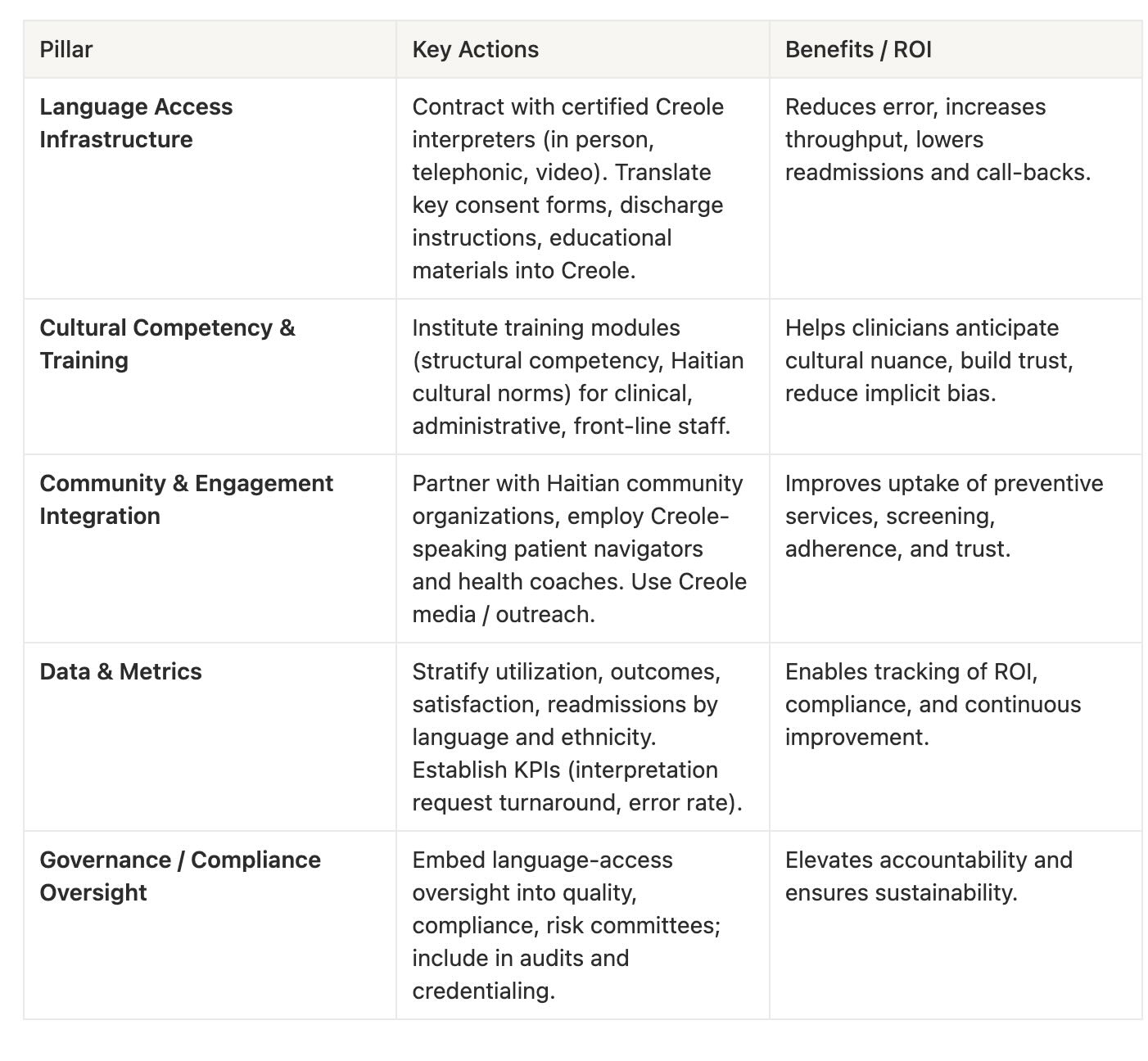
Below is a strategic, phased implementation framework targeted to CMOs, COOs and Compliance Leads.
Illustrative Use Case: Perinatal & Reproductive Health
Haitian newcomer women may carry unique risks (e.g. immunization gaps, infectious diseases screening) and cultural sensitivities. Using Creole materials and Creole interpretation lead to better prenatal adherence, reduced complications and higher satisfaction. (Minnesota Department of Health)
Sample Creole Phrases for Clinicians
While not a substitute for professional interpreters, clinicians knowing some Creole phrases can build rapport. (E.g. “Kijan ou santi ou jodi a?” = “How are you feeling today?”) (Creole Solutions Blog)
Implementation Challenges & Mitigation
Interpreter fatigue / availability: use tele-interpretation to cover off-hours or remote locations. Also, AI interpretation offers instant, on-demand communication for Haitian Creole encounters, reducing wait times for language support. While medical accuracy is still improving, ongoing training is enhancing reliability. Over time, AI interpretation tools will provide faster and more precise translations.
Translation quality: use back-translation to add an extra layer of control.
Staff resistance / workflow disruption: pilot, collect user feedback, integrate AI and human interpreter workflows seamlessly.
Data invisibility: because many systems lump Haitians under African American, you must ensure ethnicity / preferred “language” fields are collected. (Stanford Medicine)
Important to have in mind, we search for the number of certified Haitian Creole medical interpreters in the US and Assume the number is limited: Because Haitian Creole is a less-commonly certified language compared to Spanish/Arabic, the pool of fully certified interpreters is likely smaller.
Interpreter Workforce Reality: Haitian Creole
When assessing interpreter capacity, it’s important to recognize that the number of certified Haitian Creole medical interpreters in the United States is extremely limited. Haitian Creole is classified as a less-commonly certified language, unlike Spanish or Arabic, which dominate national certification programs such as the Certification Commission for Healthcare Interpreters (CCHI) and the National Board of Certification for Medical Interpreters (NBCMI).
As a result, many health systems face a supply-demand gap (a small pool of credentialed interpreters serving a rapidly growing Haitian-American population). This shortage transverses healthcare settings nationwide, affecting large academic hospitals, community health centers, and outpatient clinics alike. The deficit increases operational risk, lengthens patient throughput times and raises potential compliance exposure under Title VI and Section 1557 language-access requirements.
AI-based interpretation models for Haitian Creole are advancing but remain technically complex. Haitian Creole is an advanced, high-context language whose nuanced phonology, layered idioms, and fluid code-switching between Creole and French make medical-grade translation especially demanding. Achieving consistent accuracy requires specialized linguistic datasets and adaptive AI training, ensuring that emerging tools meet clinical and compliance standards.
In practice, this means that while machine-assisted tools may eventually supplement workflows, reliable, compliant communication with Creole-speaking patients still depends on qualified human interpreters—a workforce that remains scarce and should be treated as a strategic investment area for hospitals, payers, and telehealth platforms.
Key Takeaways for CMOs / COOs / Compliance Leaders
Haitian Creole access is not optional, it is both a compliance requirement and a clinical safety imperative.
1 millions people speak Haitian Creole in the US, mainly in the state of Florida.
Investments in Creole-language infrastructure produce cost-avoidance, patient trust and differentiation in underserved markets.
Success depends on integration: interpretation + translated content + cultural training + community bridges + metrics.
Language equity must be built into governance and oversight, not left to ad hoc efforts but many health systems face a supply-demand gaps in Haitian Creole
FAQs
1. Why is Haitian Creole distinct from French in health care settings?
Haitian Creole is a separate language with its own grammar and vocabulary. Many Haitian patients prefer or understand Creole better than French when discussing health, especially sensitive topics. (Minnesota Department of Health)
2. Is providing a family member as interpreter sufficient?
No. Relying on untrained interpreters risks errors, privacy breaches or omissions. Federal/State rules generally require qualified interpreters (AI and/or human) when serving LEP populations.
3. Which departments should be prioritized for Creole language access?
Emergency, obstetrics/gynecology, chronic disease management, mental health and oncology are high-priority. Starting there yields faster safety and ROI gains.
4. How can a health system measure ROI from Creole-language investment?
Track metrics such as reduced readmissions, fewer interpreter-related delays, patient satisfaction, malpractice claims and improved outcomes in Creole-speaking subpopulation.
5. How can systems staff with enough Creole interpreters across all shifts?
Use a mix of in-person interpreters, telephonic/video remote interpretation (VRI) and compliant AI interpretation.
Eyal Heldenberg
Co-founder and CEO, building No Barrier
Eyal has 20+ years in speech-to-speech and voice AI and is the co-founder of No Barrier AI, a HIPAA-compliant medical interpreter platform. Over the past two years, he has led its adoption across healthcare organizations, helping providers bridge dialect gaps, reduce compliance risk and improve patient safety. His mission is simple: ensure health equity by removing language barriers at the point of care.









.svg)