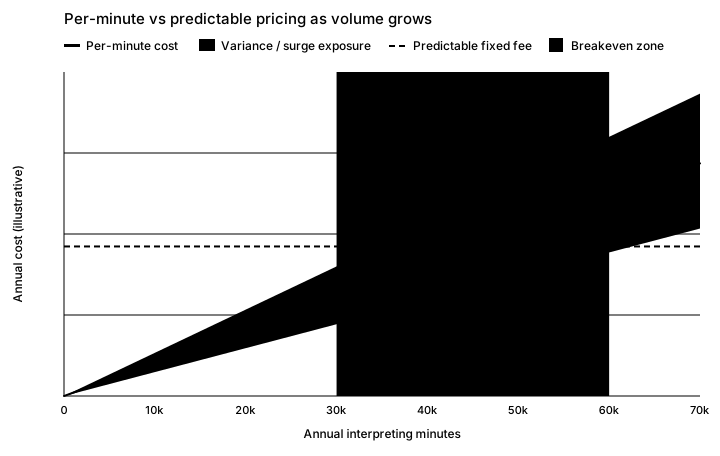
Per-minute interpretation billing scales linearly with volume and transfers all budget variance to the health system, not the vendor.
The real cost driver is variance, not the average rate: a per-minute contract offers no ceiling during a utilization spike, such as a flu season surge in LEP encounters.
For most mid-sized health systems, the breakeven point between per-minute and predictable pricing falls between 2,500 and 5,000 monthly interpreting minutes.
Predictable pricing is only as strong as its overage, underage and true-up terms. A fixed label alone does not guarantee fixed risk.
Hybrid programs, AI interpreting for high-volume encounters paired with human interpreters for emotionally complex conversations, shift a larger and more stable share of volume onto fixed-fee pricing.
A true cost model compares total annual spend across at least three utilization scenarios, not just the quoted per-minute rate.
Every health system that has priced language access has seen the same quote structure: a per-minute rate, a monthly minimum and a promise that costs will “scale with usage.” That promise is true and it is also the problem. Per-minute billing scales linearly with volume but the risk it creates for a health system's budget scales faster than linearly, because volume itself is unpredictable month to month. A true cost model has to account for both the rate and the variance around it, not just the rate.
What is the real difference between per-minute and predictable pricing for language access?
Per-minute pricing charges a fixed rate for every minute of interpreting used, so the total cost is a direct multiple of utilization. Predictable pricing charges a fixed annual or subscription fee calibrated to expected volume, so the total cost is set in advance regardless of month-to-month swings. The difference that matters to a CFO is not the average cost per minute, it is the variance: per-minute contracts transfer volume risk to the health system's budget, while predictable contracts transfer it to the vendor.
Why does variance matter more than the average rate?
A health system that budgets for 40,000 interpretation minutes a year but experiences a flu season surge to 55,000 minutes does not get a discount for the overage under a per-minute contract. It gets a bigger invoice at the same rate (maybe discounted or more expensive depending on the contract), arriving in a quarter when clinical volume and staffing costs are already elevated. Under a predictable model, that surge is absorbed inside the fixed fee, which is why finance teams increasingly treat pricing structure, not just the headline rate, as the underwriting question.
How do per-minute interpreting costs scale as volume grows?
Per-minute costs scale linearly with no ceiling, so a health system that doubles its LEP (Limited English Proficiency, meaning a patient who does not speak English as a primary language and cannot communicate effectively in English during a clinical encounter) patient volume doubles its interpretation line item exactly, with no efficiency gained from scale. For example, Community Health Centers illustrate why this matters at scale: CHCs collectively serve 52 million Americans or 1 in 7 people nationally, across more than 17,000 locations (NACHC and ScaleHealth, March 2026). A center whose LEP share grows from 20% to 30% of its patient panel, a shift many CHCs are already reporting, sees its per-minute interpreting spend rise by half with no corresponding change in its contract terms.
A 20,000-minute-a-year clinic using per-minute interpretation pays in direct proportion to its usage. If appointment volume or interpretation needs increase, the bill increases as well. Unless the contract includes a cap or other protection, there is no built-in ceiling on that variable cost.
At 50,000 minutes a year, higher volume may support a lower per-minute rate, but a lower rate does not eliminate spending variability. Government procurement guidance explicitly recognizes quantity or volume as a basis for discounts, while the actual discount depends on the supplier and contract terms.
At higher volumes, buyers can have more room to negotiate pricing and contract terms, including volume discounts or alternative structures. GSA guidance mentions that buyers can negotiate discounts and that large-volume purchasing can support better pricing, but the specific structure remains a matter of negotiation.
Does a volume discount solve the variance problem?
No. A volume discount lowers the per-minute rate at higher tiers but the health system still pays more in a high-utilization month than a low-utilization one, so the underlying budgeting problem, matching a fixed clinical operations budget to a variable vendor invoice, remains unsolved. The discount changes the slope of the cost curve, not its shape.
How after-hours interpreting can introduce additional rate variance
The cost variability can be even greater when interpreting is required outside standard operating hours. Published interpreting rate schedules show that providers may apply materially higher rates for nights, weekends and public holidays. For example, a current GSA contract lists onsite spoken-language interpreting for “other languages” at $73.07 per hour during standard hours versus $109.72 during nights, weekends and holidays; a 50% premium.
Similarly, the Northern Territory Government applies higher interpreting rates outside standard hours, with the per-30-minute rate increasing from $35 during standard weekday hours to $40.25 on weekday after-hours, $52.50 on Saturdays, $70 on Sundays and $87.50 on public holidays. A published healthcare study also documented higher after-hours rates for both telephone and onsite interpreting services. This means that a health system's interpreting spend can be affected not only by how many minutes it uses, but also by when those minutes occur, creating an additional layer of budget variance that a volume discount alone does not eliminate.
What does a predictable pricing model actually include?
A predictable pricing model bundles a defined volume band, typically annual, into a single fee that does not change with month-to-month utilization swings and it should explicitly state what happens above and below that band. The details that separate a real predictable model from a marketing label are the overage terms, the underage terms and whether the fee includes deployment and support or bills those separately. No Barrier's own pricing model, for instance, is built as a predictable annual fee specifically to remove per-minute billing from the equation, alongside a documented average encounter-time reduction from 22 minutes to 12 minutes across its deployed sites, a change that affects clinician throughput independent of the interpreting bill itself.
Where does the breakeven point sit for a hybrid AI-plus-human interpreting program?
The breakeven point between per-minute and predictable pricing depends on utilization volume and its volatility but for most mid-sized systems it falls somewhere between 30,000 and 60,000 annual interpretation minutes, the range where per-minute variance starts to exceed what a finance team can absorb without a supplemental budget request. Above that range, the dollar exposure from a single volume spike becomes large enough that a fixed-fee structure is worth negotiating even at a nominal premium over the blended per-minute rate.
In-house human interpreters are gold. They are part of the organization: they know the departments, the providers and sometimes even the patients. These teams are a fixed-cost resource but with shifts to cover nights, weekends and holidays, overtime becomes an extra cost most medical sites underweight when they model interpreter economics.
When a medical organization needs language access at scale, AI interpretation is what closes the gap. AI interpreting with No Barrier runs at a fixed cost around the clock, day shift and night shift, weekends and holidays, available instantly at the point of care. That is where the hybrid model changes the math rather than just the rate: in-house human interpreters stay the right fit for emotionally complex, relationship-driven encounters, while AI absorbs the high-volume and after-hours share of demand at a cost that does not move with the clock. The AI share of total volume, the part best suited to predictable, fixed-fee pricing, grows more stable as scale increases, while the human-interpreter share stays a fixed cost with its overtime variability concentrated at the edges of the schedule.
How should health system leaders build a true cost model, not just a rate comparison?
A true cost model compares total annual spend under realistic utilization scenarios, not the quoted rate and it should explicitly price in the operational costs that per-minute contracts hide, like encounter time, staff scheduling friction and budget forecasting overhead. California's Medi-Cal population is 40% LEP (California Health Care Foundation, 2026), which means a California safety-net provider modeling this decision cannot treat LEP volume as a rounding error. The model should run at least three scenarios: current volume, a 25% surge scenario and a 25% shortfall scenario, priced under both structures, with the resulting variance reported alongside the average cost, not instead of it.
Bottom line
the right pricing structure is not a matter of finding the lowest per-minute rate. It is a matter of matching the pricing model to how much volume variance and after-hours exposure a health system's budget can absorb, since premiums for nights, weekends and holidays can run 50% or higher on top of already-unpredictable monthly usage. Systems that model a hybrid of in-house human interpreters and always-on AI interpreting, rather than pricing a per-minute rate in isolation, are the ones that see the real number before the invoice does.
FAQs
What is the difference between per-minute and predictable pricing for medical interpretation?
Per-minute pricing charges a fixed rate for every minute of interpretation used, so total cost scales directly with utilization. Predictable pricing charges a fixed monthly fee calibrated to expected volume, so total cost is set in advance regardless of month-to-month usage swings.
Does Section 1557 require a specific pricing model for interpretation services?
No. Section 1557 of the Affordable Care Act requires that healthcare providers receiving federal funding offer qualified language assistance to LEP patients, but it does not mandate a specific billing structure. The pricing model is a budgeting decision, not a compliance requirement.
At what volume does predictable pricing become worth negotiating?
For most mid-sized health systems, it usually makes sense to discuss fixed pricing once interpretation volume reaches 2,500–5,000 minutes per month. At this level, unexpected increases in usage can have a meaningful impact on costs, making predictable pricing more valuable.
What is the main risk of staying on a per-minute contract as volume grows?
The main risk is budget uncertainty, not the average rate. With a per-minute contract, there is no ceiling on your monthly bill. A surge in LEP encounters, flu season, more emergency shifts or the continued growth in the LEP population can quickly increase interpretation costs. Your invoice goes up with usage, while the contract terms stay the same.
Can No Barrier help make interpreting costs more predictable?
Yes. No Barrier can provide a more predictable cost structure, helping health systems plan their budgets with greater confidence. Judd Semington, CEO of Community Clinic NWA, highlights how No Barrier helped his organization gain predictable interpretation costs. See testimonial here.
Eyal Heldenberg
Co-founder and CEO, building No Barrier
Eyal has 20+ years in speech-to-speech and voice AI and is the co-founder of No Barrier AI, a HIPAA-compliant medical interpreter platform. Over the past two years, he has led its adoption across healthcare organizations, helping providers bridge dialect gaps, reduce compliance risk and improve patient safety. His mission is simple: ensure health equity by removing language barriers at the point of care.









.svg)