USE CASE
 
Ophthalmology

From 22 minutes to 12.
The same visit, twice as fast.

Pacific Eye Associates is the most comprehensive multi-specialty ophthalmology practice in the San Francisco Bay Area, serving a patient base where 40% of encounters require language access. Their top languages are Cantonese, Mandarin, Russian, Spanish, Vietnamese, Korean and Japanese. After years of phone-based interpretation that added 5 to 10 minutes of wait time per encounter and left physicians struggling with audio quality and repetition, Executive Director Corinne Knowles evaluated four competing solutions and deployed No Barrier across the full practice.
California
Multi-location
Ophthalmology
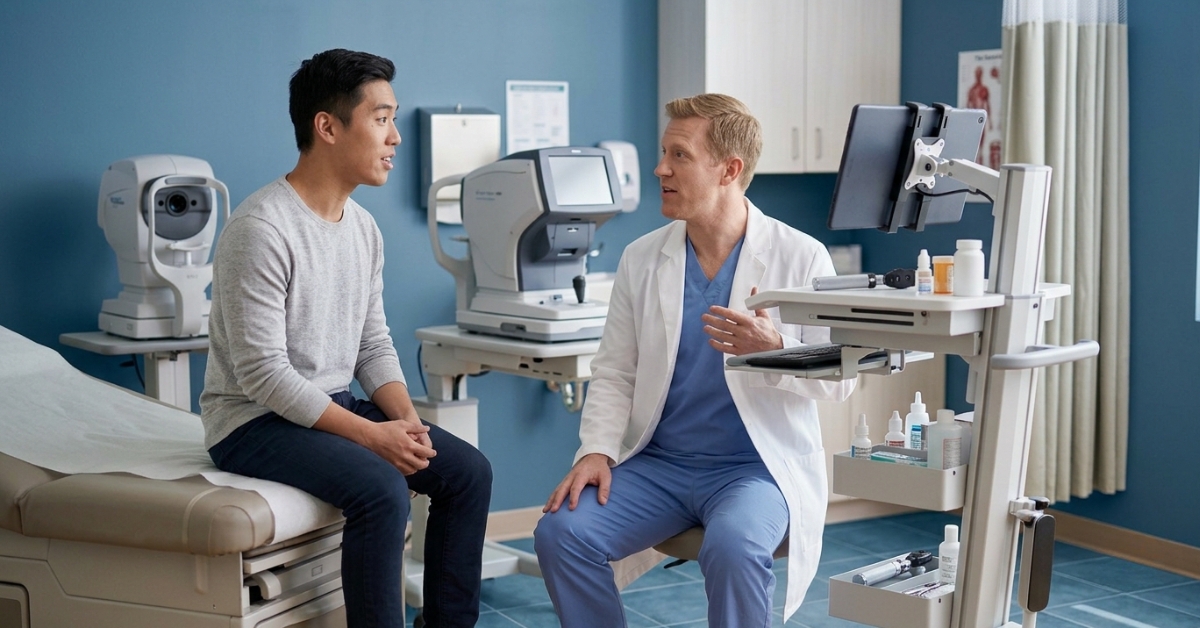
Pediatric provider consulting with a child and parent at Steamboat Pediatrics using No Barrier interpretation
Multi-location
California

Before No Barrier

  • Five to ten minutes of wait time before every LEP encounter. Physicians had to track down a shared device, queue into a live agent line and wait before a single clinical word was spoken.
  • Audio quality compounded the language barrier. With an average patient age of 40 to 70, poor call audio on top of a language gap turned basic conversations into shouting matches between agent, physician and patient.
  • No continuity across the patient journey. A call started with a technician did not carry over to the physician. Every handoff meant a new dial-in, new wait time and repeated instructions.
  • Language was a scheduling constraint. Clinicians padded time blocks for LEP patients, capping daily volume before the appointment even started.

Why No Barrier

Pacific Eye Associates tested No Barrier against bilingual and multilingual staff across Cantonese, Mandarin, Russian, Spanish, Vietnamese, Korean and Japanese before committing. The technology matched native-speaking accuracy across all tests. On-screen, hands-free interpretation removed the dial-in entirely, the live transcript gave providers a record of every instruction given and a flat monthly subscription made cost predictable regardless of volume. It is HIPAA and SOC 2 Type II certified.
“Now with No Barrier, we get that audio and visual, and I have to say it's one of my physician's favorite things. For one, there's no more repetition. The AI understands what's being said. It feeds it back and it transcribes in both languages for the physician and for the patient.”
“One of my nurses was just saying how much better No Barrier is vs a human translator where it is so much smoother. They feel like they could be themselves.”
Corinne Knowles · Executive Director · Pacific Eye Associates · California · June 2026
Pacific Eye Associates · California

How it runs in practice

Locations

Multi-location ophthalmology practice, San Francisco Bay Area

Workflows

Front desk, scheduling, surgical coordination, technician workup and physician exam rooms

Top languages

Cantonese, Mandarin, Russian, Spanish, Vietnamese, Korean, Japanese and 13+ more, part of 295+ language access options

Devices

Existing tablets and mobile devices across all departments, dozens simultaneously

What changed for Pacific Eye Associates

Across all LEP encounters at Pacific Eye Associates:
Across all locations in California.

22→12

minutes per encounter

30%

more patients seen per day

Flat

monthly cost
Encounter time cut from 22 to 12 minutes across all LEP encounters: no protocol change, no added staff.
30% more patients seen per day over two seasons as clinicians removed time padding for LEP appointments entirely.
No per-minute billing, no scheduling, no hold time: interpretation connects in seconds on any device, with a live transcript in both languages.
Live transcript gives physicians and patients a real-time record of every clinical instruction, in both languages.
We're lucky enough to have staff that speak Cantonese or Mandarin. We just can't clone them across 20 exam rooms and have them be in 40 places at once across different clinics.  But we found that the technology is intelligent enough to compete with those bilingual staff and patients have been really grateful and quite happy with it.
Today it is much more facilitative to be able to bring in that technology, to be able to engage with that patient in real time.
Corinne Knowles · Executive Director · Pacific Eye Associates
California · June 2026
In ophthalmology, precision communication is part of the clinical act. A provider asking a patient to look at a specific point, follow a light or hold still during a procedure needs the interpreter to disappear into the background, not sit on a speakerphone in the room. No Barrier runs on-screen, hands-free and keeps the clinical relationship between provider and patient. The result at Pacific Eye Associates was 10 minutes back per encounter and a practice that could see 30% more patients without adding staff. Talk to us about pricing
Frequently asked questions
Q1.
How does No Barrier reduce encounter time in ophthalmology visits?

Phone interpretation adds hold time and connection delays before a single word is spoken. No Barrier connects in seconds, runs hands-free on an existing device and keeps the provider focused on the patient. At Pacific Eye Associates, encounter time dropped from 22 to 12 minutes across LEP visits.

Q2.
Can AI medical interpretation handle specialty terminology in ophthalmology?

Yes. Pacific Eye Associates tested No Barrier against bilingual and multilingual staff across multiple accents and dialects before committing. The technology matched the accuracy of native-speaking employees across Cantonese, Mandarin, Russian, Spanish, Vietnamese, Korean and Japanese.

Q3.
What happens to interpreter wait times when a practice switches to AI interpretation?

Pacific Eye Associates previously waited five to ten minutes per encounter to connect with a live phone agent. After switching to No Barrier, connection is immediate. Average encounter time dropped from 22 to 12 minutes and clinicians increased volume by 30% over two seasons.

Q4.
How do patients respond to AI interpretation in a clinical setting?

At Pacific Eye Associates, zero patients declined and zero patients complained after the switch. Many did not realize they were interacting with AI. The practice discloses AI use through written and verbal consent as standard protocol. Patients from 40 to 70 found the on-screen transcript easy to follow and the audio quality competitive with native-speaking staff.

See No Barrier in your clinic

22 to 12 minutes per encounter · 30% more patients seen · flat monthly cost.
Book a Demo
Book a Demo