Language access for LEP PATIENTS
LEP compliance is a federal requirement for healthcare organizations in the United States. As limited English proficiency patients increase, accurate patient communication becomes critical to maintaining clinical flow, controlling risk and supporting equitable care.
See how AI interpreting worksIn the United States, approximately 29.6 million people are LEP patients in healthcare settings: they do not speak English as their primary language and have a limited ability to read, speak, write or understand English.
This growing healthcare population increases regulatory exposure for medical sites subject to federal language access requirements.
As LEP patient volume rises, maintaining compliant patient communication becomes increasingly difficult without reliable systems in place.
Title VI of the Civil Rights Act
Language access in telehealth
Language access obligations throughout the patient journey
Human or AI interpreting based on patient preference
Documentation and consistency expectations
The SPEAK Act (signed February 3, 2026) requires HHS telehealth guidance by February 2027.

Interpreting is not there when the provider walks in, so the visit stalls and the patient either waits or has to be rescheduled.
Language access spans the whole journey, from scheduling to test results, across phone, video and in person.
Per-minute billing pressures visit time and grows language access with every added patient.
The solution
Every challenge above comes back to the same thing: interpreting that is not there the moment patients and providers need it. No Barrier bridges that gap.
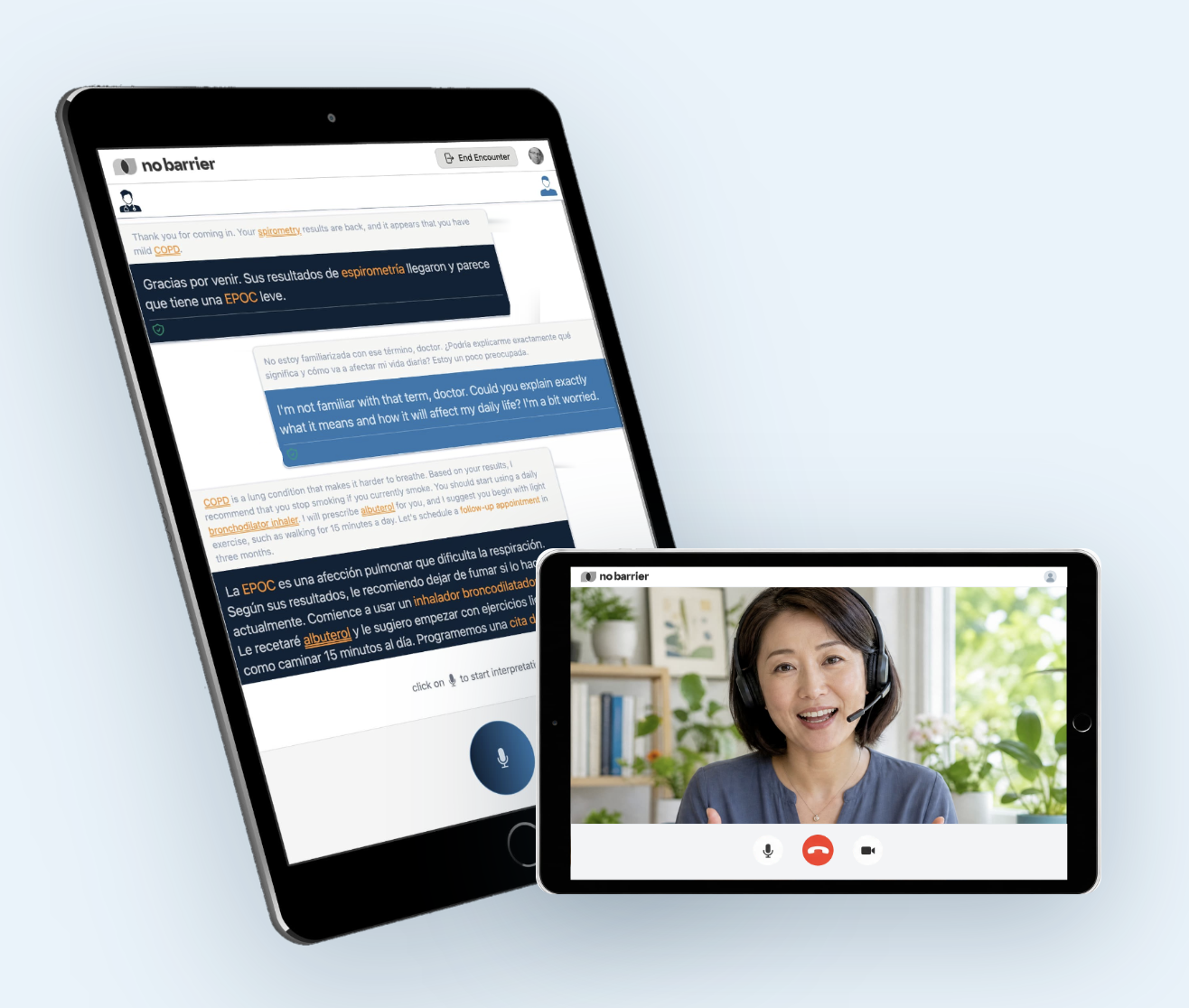
See how CEO Judd Semingson shares the impact of No Barrier on rising LEP patient demand.
Expert Use Case →


See how instant interpreting fits your workflow and what it costs at your volume.
Schedule a Demo