Language Access ROI: Clearing the New 3x Bar on AI Spend
Health executives now expect 3x or more from AI spend. Here is how to measure language access ROI by the same standard, with a five-step method and the evidence behind it.
Language access ROI is the measurable return a health system earns when patients with limited English proficiency (LEP) can talk with their care team at every touchpoint, without delay. In budget reviews, the interpreting line often comes up late, after revenue cycle tools and ambient scribes. That order is worth revisiting. A September 2026 survey of 303 healthcare executives by Bain & Company and KLAS Research found that leaders now expect technology to pay for itself quickly, and that organizations with a formal AI return threshold most often set it at 3.0 to 3.9 times the original investment. Interpreting can be measured against that same bar.
What changed in how health executives judge AI and IT spending?
Health executives still rank IT as a top priority, but each tool must now prove a specific use case, a measurable return and a short time to value. The priority held steady; the burden of proof rose.
According to the Bain & Company and KLAS Research 2026 Provider and Payer Healthcare IT Survey, about 95% of providers and payers rank software and digital technology among their top five strategic priorities. The same research describes a shift in tone. Early AI adoption ran on optimism and board pressure to experiment. Rising spend has moved cost and accuracy to the front, and the authors expect return on investment to decide which programs keep their funding.
Three details from the survey matter for anyone who owns language access:
Returns are measured in three ways. Organizations most often track cost savings, revenue uplift and productivity gains. Any interpreting business case should report in those same terms.
Many organizations have no formal hurdle yet. Among those that do, 3.0x to 3.9x is the most common threshold. That leaves room for leaders to define the measure before a vendor defines it for them.
Patient access is a top investment area. Roughly 40% of acute care providers and about 65% of independent physician groups named patient access and engagement tools as a top three priority. Language is part of access, even when it is not labeled that way on the budget.
One honest caveat: the survey does not break out FQHCs or Community Health Centers as their own group. Health center leaders should read the findings as a signal of where the market is heading, not as a benchmark built for their setting.
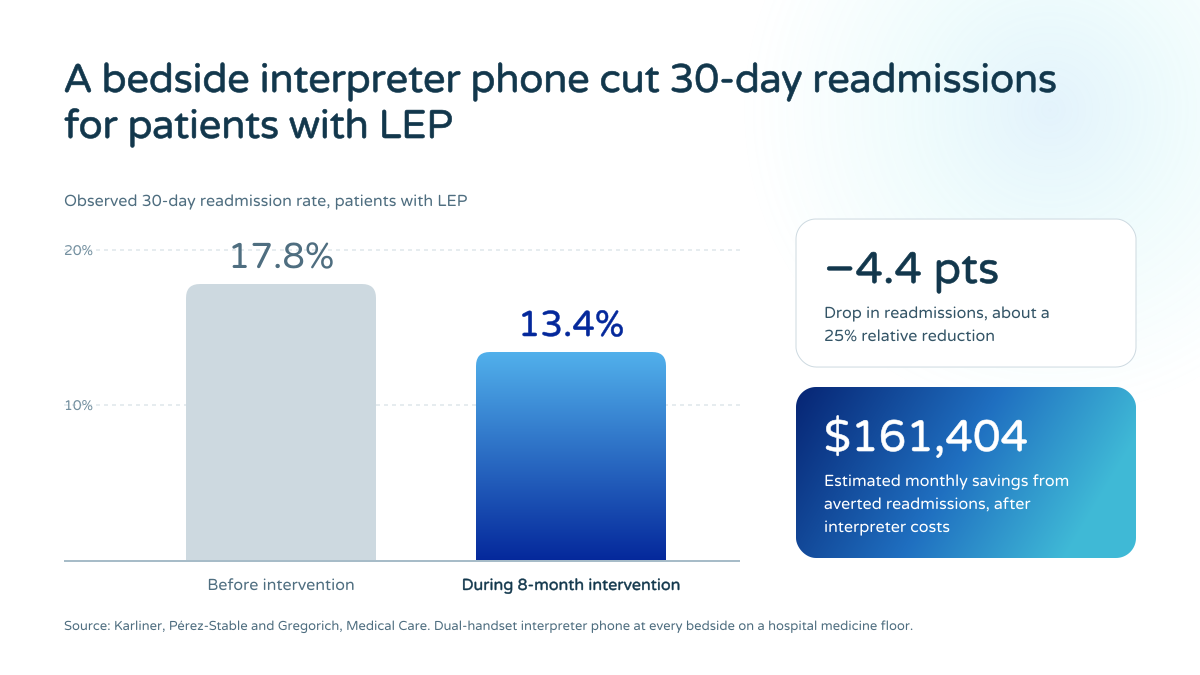
Observed 30-day readmission rate, patients with LEP
Why does interpreting belong in an AI ROI review?
Interpreting affects cost, productivity and patient outcomes at the same time, the three return categories executives already track. It is a federal obligation, a variable operating cost and a lever on outcomes that carry real dollars.
Start with scale. The GSA Translation and Interpretation Services Ordering Guide (December 2025) estimates that about 29.6 million people in the United States have limited English proficiency. For many health centers, that population is a large share of the patient panel, not an edge case.
Next, cost. Under per-minute billing, spend rises with every encounter. Finance teams struggle to forecast it and department leaders feel pressure to keep calls short or skip them. That pressure works against the outcomes the service exists to protect.
Then, productivity. Every minute a clinician waits for a connection, repeats a question or reschedules a visit because the right language was not available is capacity the organization pays for and does not use. These costs rarely appear on an interpreting invoice but they show up in throughput, overtime and patient experience scores.
Finally, outcomes. A peer-reviewed study in Medical Care by Karliner, Pérez-Stable and Gregorich tested a simple change on a hospital medicine floor: a dual-handset interpreter phone at every bedside. During the eight-month intervention, the observed 30-day readmission rate for patients with LEP fell from 17.8% to 13.4%. After subtracting interpreter service costs, the authors estimated the averted readmissions saved the hospital about $161,404 per month.
The most useful finding for ROI planning came afterward. When the phones became harder to reach, the readmission benefit faded. The return did not come from having a service under contract. It came from how easy that service was to use at the moment of care. The study predates today's AI tools, yet the lesson transfers directly: the return follows access, whatever technology delivers it.
How should a health system build the ROI case for interpreting?
Build the interpreting ROI case like any other AI investment review: baseline, target, pilot, measure. The steps below give each owner a clear job and a clear deadline.
Baseline current spend (owner: finance, weeks 1 to 2). Pull 12 months of invoices. Break minutes down by site, department, modality and hour of day. Add the hidden costs: bilingual staff pulled from their roles, vendor minimums and overtime for scheduling.
Size the unmet demand (owner: language services lead, weeks 2 to 3). Compare encounters with a recorded non-English language preference against encounters with documented interpreting. Use a full quarter of data or more so seasonal swings do not distort the picture. The gap is both a compliance exposure and a sign that care may be taking longer than it should.
Choose two or three outcome metrics you already track (owner: quality, week 3). Good candidates include 30-day readmissions, no-show rates, visit length and discharge follow-up, each stratified by language preference. Avoid building new measures for the pilot; existing dashboards are more credible to a CFO.
Set a time-to-value window (owner: COO, week 4). Agree up front on how long the pilot runs and what result would justify expansion. One quarter is a practical starting point.
Report the return as a multiple (owner: finance, end of pilot). Add avoided costs, recovered staff time and any revenue effect from kept appointments. Divide by total program cost. Compare the result with the organization's own hurdle, or with the 3.0x to 3.9x range the survey reports.
In one line: ROI multiple = (avoided costs + recovered staff time + retained revenue) divided by total program cost.
What belongs in the numerator and the denominator?
The numerator should hold only benefits the organization can trace: readmissions avoided on the chosen metric, staff hours returned to their core roles, kept appointments that would otherwise have been rescheduled and vendor fees that no longer apply.
The denominator should hold the full program cost, including subscription or usage fees, staff time spent on rollout and training and any devices the teams need. Leaving rollout time out of the denominator flatters the result and weakens the case in the next budget cycle.
Step two keeps the numbers honest. Invoices show the minutes the organization paid for, not the encounters with a recorded language preference that had no interpreting documented. Reading both figures side by side shows whether a low spend line reflects efficiency or a gap in access.
What does the pricing model have to do with the return?
Interpreting pricing shapes how often teams use the service and usage drives the return. The bedside phone study shows that value follows ease of use, so a model that charges for every minute works against the very usage that produces savings.
A flat monthly subscription changes the math in three ways.
- Spend becomes predictable, which makes the ROI multiple easier to calculate and defend.
- Clinicians and front desk teams stop rationing calls.
- And the cost per encounter falls as adoption grows, so every additional use improves the return instead of eroding it.
This is the model No Barrier uses. AI-first medical interpreting runs in the same interface for speech-to-speech, phone and video interpreting, on a flat monthly subscription that replaces per-minute billing. It is available 24/7, including night shifts, at every patient touchpoint: inpatient units, call centers, telehealth video and bilingual discharge letters, across 295+ language access options. For a deeper look at the cost side, see this breakdown of how health systems reduce interpreting costs.
Finance leaders can pressure-test any interpreting model, including this one, with a short list of questions.
- What does the organization pay if volume doubles next year?
- Which touchpoints are covered and which are billed separately?
- How quickly can a clinician start a session at 2 a.m.?
- What usage and outcome reporting comes with the service?
The answers turn a pricing sheet into an ROI forecast.
Language access ROI tends to erode after go-live, not before it. Lessons from deployments across 300 sites, from pediatrics to urology to oncology, point to five recurring issues any health system can plan around.
Treating go-live as the finish line. Usage often dips once the launch energy fades. Simple tools help patients ask for support themselves; front desk signage such as "Point your language" is one example.
Measuring spend but not outcomes. A lower invoice is only half the case. Pair the cost report with the outcome metrics chosen in step three.
Launching in one department. Value compounds across touchpoints. A patient helped at intake but not at discharge still carries readmission risk.
Reviewing usage too rarely. Monthly usage reports by site during the first quarter surface dips while they are still easy to fix.
Leaving ownership vague. Name one operational owner and one executive sponsor. A dedicated Customer Success team can support that owner with a customer-level governance layer, but it cannot replace internal accountability.
The Care Culture Talks podcast features conversations with healthcare leaders on language access and AI, a useful place to hear how peers approach these decisions.
Scrutiny of AI spend has arrived and interpreting should face the same test as every other tool. Measure it by access and outcomes, not only by invoice size and choose a pricing model that rewards use. No Barrier tracks this with a cost benchmark across its deployments: every client to date has reduced annual interpreting costs by 30% to 50%. Reach out to assess the ROI of your language access program.
FAQs
What ROI do health executives expect from AI investments in 2026?
Health executives expect fast, measurable returns from AI. A 2026 Bain & Company and KLAS Research survey of 303 healthcare leaders found that organizations with a formal threshold most often require 3.0 to 3.9 times the original investment. Returns are usually measured as cost savings, revenue uplift and productivity gains, and leaders want a specific use case with short time to value.
How can a health system measure the ROI of medical interpreting?
A health system can measure interpreting ROI by baselining 12 months of spend, sizing unmet language demand and tracking two or three existing outcome metrics by language preference. Finance then divides traceable benefits, such as avoided readmissions and recovered staff time, by full program cost. No Barrier's flat monthly subscription simplifies the denominator because program cost is known in advance.
Can better access to interpreting reduce hospital readmissions?
Yes, easier access to professional interpreting has been linked to fewer readmissions. A peer-reviewed study in Medical Care found that bedside interpreter phones cut the 30-day readmission rate for patients with limited English proficiency from 17.8% to 13.4%, with estimated net savings of about $161,404 per month. The benefit faded when access became less convenient.
Why does per-minute billing make interpreting ROI harder to prove?
Per-minute billing makes interpreting spend rise with every encounter, which makes budgets hard to forecast and can push teams to shorten or skip calls. Research shows that value follows ease of use, so rationing undermines the return. No Barrier replaces per-minute billing with a flat monthly subscription, which keeps costs predictable as usage grows. CAN Community Health saved $17,000 a year after making the switch.
Where does No Barrier fit in an AI ROI review?
No Barrier fits as an operations investment with measurable cost and outcome effects. It provides AI-first medical interpreting in the same interface across 295+ language access options, 24/7, at inpatient, call center, telehealth and discharge touchpoints. It runs on a flat monthly subscription, is HIPAA compliant and SOC 2 Type II certified and has been deployed across 300 sites.
Moe Abramovitch
Co-founder and COO, building No Barrier
Moe is a senior technology leader with a strong background in software development and operations. He specializes in bridging advanced AI with real-world healthcare workflows, ensuring technology fits into clinical environments. Beyond operations, Moe documents his journey and shares practical tips with healthcare leaders, offering guidance on AI adoption, organizational change and operational excellence.









.svg)