The National CLAS Standards: A Practical Guide for Health Systems
The 15 National CLAS Standards give health systems a shared blueprint for care that meets people in their own language and culture. Here is what they ask for and how to make them real.
The National CLAS Standards. A map for healthcare leaders.
What are the National CLAS Standards?
The National Standards for Culturally and Linguistically Appropriate Services in Health and Health Care, known as the CLAS Standards, are a set of 15 guidelines published by the U.S. Department of Health and Human Services Office of Minority Health. Their purpose is to advance health equity, improve quality and help eliminate disparities by giving health and health care organizations a blueprint for responding to the cultural and language needs of the people they serve.
The standards were first released in 2000 and enhanced in 2013. The most recent revision, published in June 2025, brings digital needs into the picture, recognizing that patients now meet us through portals, apps and screens as much as through the front desk.
One thing worth saying clearly: the CLAS Standards are a framework, not a scorecard. They are meant to be adopted at the pace and scale that fits your organization.
The Principal Standard: the heart of it all
Standard 1 is the one everything else supports. It asks organizations to provide effective, understandable and respectful care that responds to cultural health beliefs and practices, preferred languages, health literacy and other communication needs.
If you only remember one thing from this post, remember this one. The other 14 standards are simply the "how."
Theme 1: Governance, leadership and workforce (Standards 2 to 4)
These standards are about making CLAS part of how an organization is run.
They ask leadership to support CLAS through policy, practice and real resources.
They ask organizations to recruit and support a workforce that reflects and responds to the digital, cultural and language needs of the community.
And they ask for regular training so that CLAS stays alive in daily practice.
Theme 2: Communication and language assistance (Standards 5 to 8)
Standard 5 asks organizations to offer language assistance at no cost to patients with limited English proficiency or other communication needs, so they have timely access to all services.
Standard 6 asks that people are told, both in writing and verbally, that this help exists.
Standard 7 focuses on the competence of whoever provides language assistance and it specifically discourages relying on untrained individuals or minors as interpreters.
Standard 8 asks for easy-to-understand print and digital materials and signage in the languages common in your service area.
Theme 3: Engagement, continuous improvement and accountability (Standards 9 to 15)
The final group is about learning and staying connected to the community. It covers setting CLAS goals and weaving them into planning and operations, assessing progress as part of quality improvement and collecting accurate demographic data to understand impact. It also asks organizations to assess community needs, partner with the community on design and evaluation, build culturally appropriate ways to resolve complaints and share progress openly with stakeholders and the public.
Why this work is hard (and why that's okay)
Let's be honest about the context. According to the GSA's December 2025 Translation and Interpretation Services Ordering Guide, 29.6 million people in the United States have limited English proficiency. Health centers serve many of them, often in dozens of languages, with teams that are already doing more than their job descriptions say.
Traditional language access models can make this harder than it needs to be.
Per-minute billing turns every interpreted conversation into a cost decision.
Wait times can stretch.
Staff who are bilingual get pulled into interpreting without training or support.
Telehealth platforms are not widely available translated.
None of this is a failure of values. It is a failure of infrastructure and infrastructure can be fixed.
Where to start
You don't have to tackle all 15 standards at once. A few steps tend to create real movement.
Start by looking at your own data. Which languages do your patients prefer and how often are interpreters actually used in those encounters? The gap between those two numbers tells you a lot.
Next, talk to the people closest to the work. Front desk staff, nurses and community health workers usually know exactly where language access breaks down.
Then pick one standard to strengthen this quarter. For many organizations, Standard 5 (timely access) or Standard 7 (qualified interpreters instead of family members) is a natural first choice because the impact on patients is immediate.
Finally, share what you learn. Standard 15 is not about perfection. It is about transparency and communities respond well to organizations that show their work.
Where technology can help
I'll be direct about why we built No Barrier. We saw committed health systems being held back by tools that made language access slow, expensive and unpredictable.
No Barrier has now been deployed across 300 sites, from pediatrics to urology to oncology, in clinical encounters and in the administrative moments around them, like scheduling, registration and billing questions. That breadth has taught us what language access really needs to look like on a busy clinic day. It has to start in seconds, in the same interface care teams already use for in-patient, phone and video interpreting. It has to cover the languages a community actually speaks, which is why we built 295+ language access options. And it has to be priced so that no one hesitates, which is why a flat monthly subscription replaces per-minute billing, all within a HIPAA compliant, SOC 2 Type II certified platform.
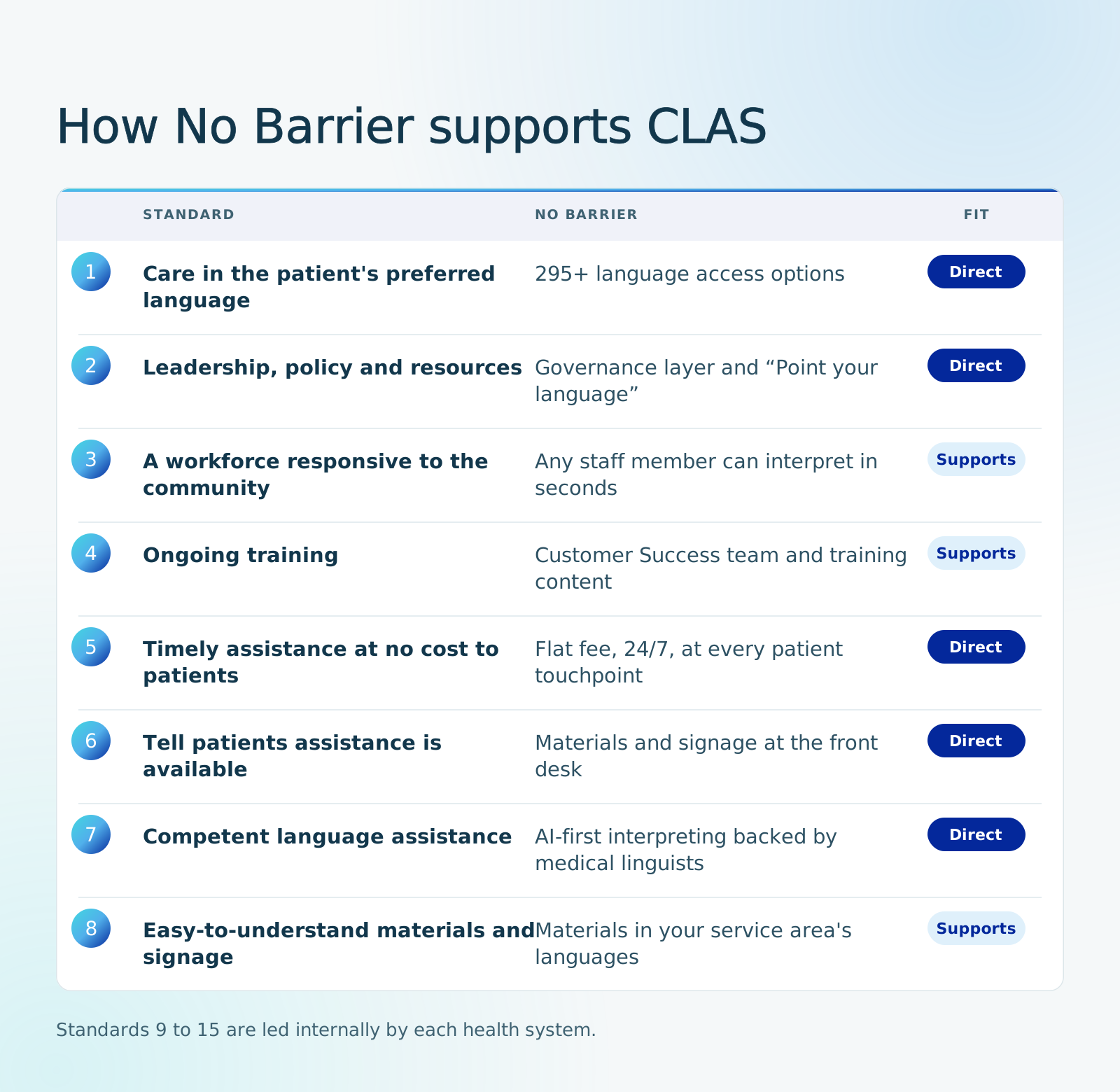
In CLAS terms, that supports Standard 5 by making timely access the default rather than the exception. It supports Standard 7 by giving teams a qualified alternative to asking a relative or a child to interpret. And predictable pricing makes it easier for leadership to commit resources under Standards 2 and 9.
How No Barrier support CLAS
A closing thought about CLAS
The CLAS Standards describe the kind of care every one of us would want for our own families: care we can understand, delivered by people who respect who we are. Care that is culturally competent. Health systems are already working toward that every day. Our job, as partners, is to make the path a little easier.
FAQs
What are the National CLAS Standards?
The National CLAS Standards are 15 guidelines from the HHS Office of Minority Health that help health organizations deliver care that responds to patients' cultural and language needs. They are organized around one Principal Standard and three themes: governance and workforce, communication and language assistance and engagement and accountability.
Are health systems legally required to follow the CLAS Standards?
The CLAS Standards themselves are voluntary guidelines. However, several of them, especially the language assistance standards, align closely with federal obligations under Title VI of the Civil Rights Act and Section 1557 of the Affordable Care Act. Organizations should review their specific requirements with legal counsel.
How does No Barrier help health centers meet CLAS Standard?
The National CLAS Standards require timely language assistance at no cost to the patient, at every point of contact. No Barrier delivers AI-first medical interpreting 24/7 across 295+ language access options, backed by medical linguists, with front desk signage (on-demand) and audit logs that help health centers document their language access over time. Reach out to see how we support your CLAS plan.
Can No Barrier replace family members or untrained staff as interpreters?
Yes and that is one of the most common reasons health centers adopt No Barrier. CLAS Standard 7 discourages using untrained individuals or minors as interpreters. No Barrier gives care teams an immediate, qualified alternative, so patients never have to rely on a child or relative to understand their care.
Where should a community health center start with CLAS on a limited budget?
Begin with your patient language data and one priority standard, such as timely access or interpreter quality. Predictable costs make a big difference here: No Barrier runs on a flat monthly subscription that replaces per-minute billing so teams can expand language access without worrying about each additional conversation.
Eyal Heldenberg
Co-founder and CEO, building No Barrier
Eyal has 20+ years in speech-to-speech and voice AI and is the co-founder of No Barrier AI, a HIPAA-compliant medical interpreter platform. Over the past two years, he has led its adoption across healthcare organizations, helping providers bridge dialect gaps, reduce compliance risk and improve patient safety. His mission is simple: ensure health equity by removing language barriers at the point of care.









.svg)