Medication Instructions for LEP Patients: What a New Study Reveals
A 2026 survey of 169 prescribers shows few know if patients with limited English proficiency get medication instructions they can read. Here is what to fix.
Medication instructions are the point where a clinical decision becomes a task a patient must carry out alone at home. For the 29.6 million people in the United States with limited English proficiency (GSA, 2025), that handoff often happens in a language they cannot read. A 2026 survey of 169 outpatient prescribers, published in The Annals of Family Medicine, shows how uncertain the process remains, even inside a large academic medical center. This post summarizes the findings, names the operational gaps behind them and explains where a same-interface interpreting workflow can help close them.
What did the Annals of Family Medicine study find?
Prescribers want patients to understand their medications. So medications should be delivered in the patient's language.
Pharmacies that receive federal funding already carry an obligation to offer language support so patients can follow their prescriptions. Manzor and colleagues set out to learn how that obligation looks from the prescriber's side. Their survey of outpatient prescribers surfaced a consistent pattern of uncertainty:
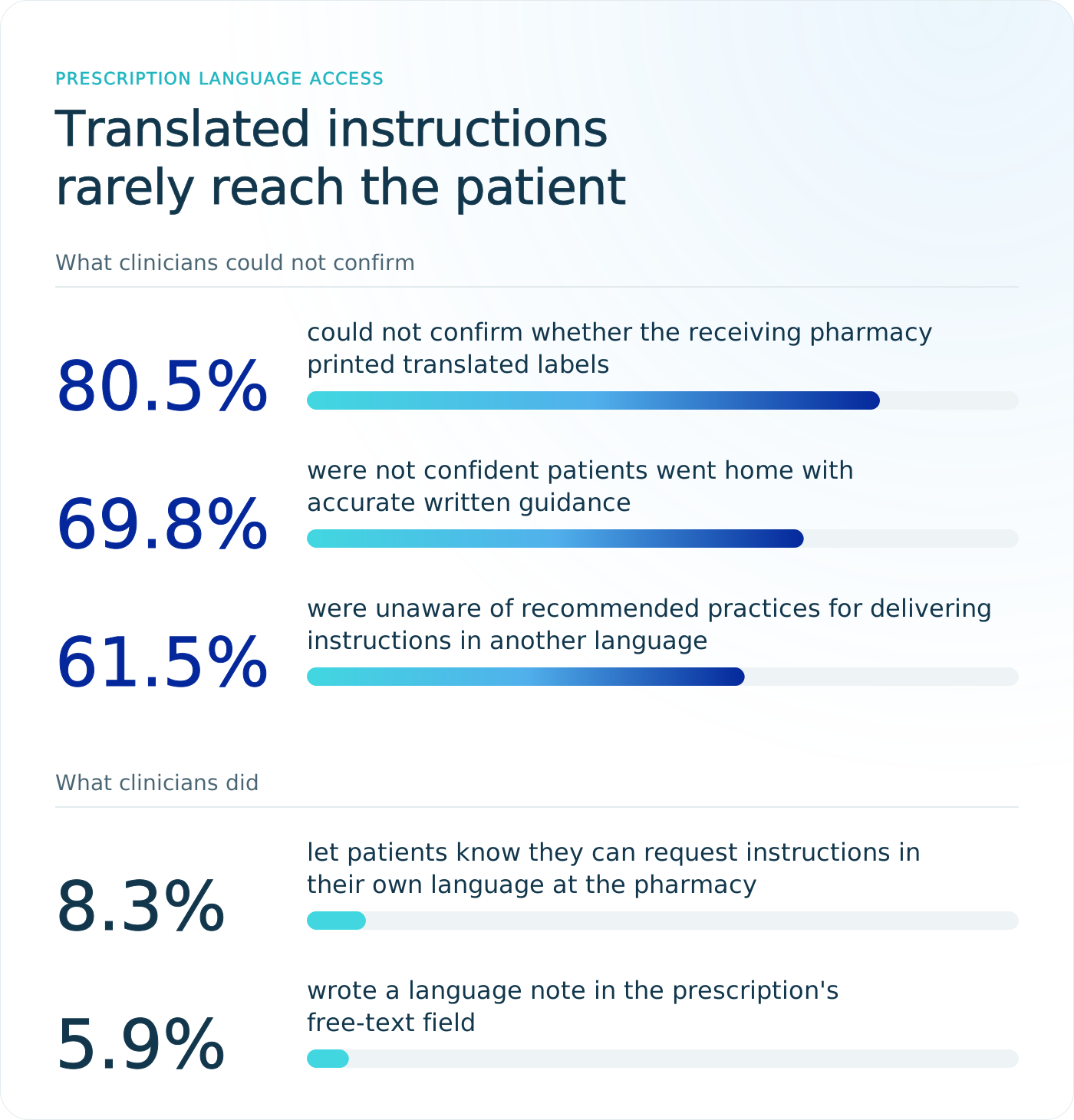
61.5% were unaware of recommended practices for delivering instructions in a language other than English.
80.5% could not confirm whether the receiving pharmacy printed translated labels.
Only 5.9% wrote a language note in the prescription's free-text field.
More than a quarter (27.8%) had no way of knowing whether their translation requests arrived.
Just 8.3% let patients know they have the option to request instructions in their own language at the pharmacy.
Nearly seven in ten (69.8%) were not confident patients went home with accurate written guidance.
The authors conclude that language services need to be coordinated across institutions and among patients, prescribers and pharmacy teams, rather than left to each party on its own.
Prescription Language Access Chart, extracted from the study
What issues sit behind these numbers?
The gaps are infrastructure problems. Prescribers named four main obstacles: time constraints (69.2%), a lack of translation resources (62.7%), difficulty reaching interpreters between visits (51.5%) and not being able to write in a non-Latin alphabet (40.8%).
Read together with the survey results, six operational issues stand out:
No shared playbook. Prescribers lack a clear, institution-wide process for non-English medication instructions, so each clinician improvises.
A broken signal to the pharmacy. Language needs are rarely flagged on the prescription and when they are, no confirmation comes back.
Patients are not told their options. Few patients learn they can request instructions in their language, so the request never happens.
Visit time pressure. Counseling on dosing and side effects takes longer with interpreting, and the clock is already tight.
Missing written resources. Without translated materials or the ability to write in scripts such as Arabic, Chinese or Russian, written guidance defaults to English.
The between-visit gap. Medication questions often come up after the patient leaves, when an interpreter is hardest to reach.
How can No Barrier help close the language access gap at the pharmacy
Closing the language access gap in pharmacy means interpreting has to be present wherever the patient is when a medication is prescribed, explained or questioned. No Barrier is built for every patient touchpoint, from the exam room and the call center to telehealth video and the pharmacy, so the medication conversation continues in the patient's language from prescription to pickup.
Time without the meter running. No Barrier provides AI-first medical interpreting, on a flat monthly subscription that replaces per-minute billing. Clinicians and pharmacy teams can take the extra minutes that dosing counseling and teach-back require, because a longer conversation no longer means a higher bill. That speaks directly to time constraints, the barrier 69.2% of prescribers named first.
Written instructions that travel with the patient. Bilingual discharge letters give the patient a written summary in their language next to the English version. No one on the care team needs to write in a non-Latin script, and the patient, caregivers and pharmacy staff all read the same instructions side by side.
Coverage between visits. Interpreting is available 24/7, including night shifts, across inpatient care, call centers and telehealth video. When a patient calls back unsure about a dose or a refill, the nurse line, care team or pharmacy can answer in the patient's language, closing the gap that 51.5% of prescribers reported.
One playbook across every touchpoint. A customer-level governance layer lets each organization set its own language access protocols and apply them the same way from the front desk to the pharmacy. Tools such as "Point your language" signage help patients identify their language at the first touchpoint, so the need is known before a prescription is written. The dedicated Customer Success team can help care teams build the habits the study found missing, such as flagging language needs in the prescription's free-text field and telling patients they can request instructions in their language.
All of this runs on 295+ language access options, backed by medical linguists, at no cost to the patient. Across 300 deployed sites, from pediatrics to urology to oncology, one lesson holds: language access works when interpreting is ready at the moment of need. The lessons on reducing waiting time for interpreting apply just as directly at the pharmacy.
What can health center leaders do this quarter?
A few low-effort steps can move the numbers in this study without waiting for a new system.
Write a one-page protocol for non-English medication instructions and share it with every prescriber.
Make the free-text language flag a default step in the prescribing routine.
Ask top referral pharmacies which languages they print labels in, and share that list with care teams.
Add a line to visit closing scripts telling patients they can request instructions in their language.
Confirm interpreting is reachable for medication callbacks after hours.
Frontline perspectives on these handoffs come up often on Care Culture Talks, No Barrier's podcast on language access and AI in healthcare.
Reach out to see how No Barrier fits your organization's workflow, including pharmacy.
Source: Manzor, B., et al. (2026). Prescriber Practices and Barriers to Providing Prescription Medication Instructions for Patients With a Non-English Language Preference. The Annals of Family Medicine. DOI: 10.1370/afm.250777.
FAQs
What did the 2026 Annals of Family Medicine study find about medication instructions and language access?
The study found that prescribers are widely unsure whether patients with limited English proficiency receive medication instructions they can understand. Among 169 outpatient prescribers, 80.5% did not know if pharmacies provided translated labels, only 5.9% flagged language needs on prescriptions and 69.8% doubted patients got accurate written instructions. Time constraints and missing translation resources were the top barriers.
Why do prescribers struggle to provide translated medication instructions?
Prescribers struggle mainly because of workflow constraints rather than willingness. In the 2026 survey, the most cited barriers were time constraints (69.2%), a lack of translation resources (62.7%), difficulty reaching interpreters between visits (51.5%) and the inability to write in non-Latin alphabets (40.8%). Each points to missing infrastructure around the medication handoff.
How does No Barrier help clinicians explain medications to LEP patients?
No Barrier gives clinicians AI-first medical interpreting for in-patient, phone and video encounters. Bilingual discharge letters then give patients written instructions in their language alongside the English version.
Can No Barrier support medication questions after the visit?
Yes. No Barrier is available 24/7, including night shifts, across call centers, telehealth video and inpatient settings. When a patient calls back with a question about a dose or side effect, the nurse line or care team can answer in the patient's language, closing the between-visit gap that 51.5% of surveyed prescribers identified.
Are pharmacies required to provide language support for medication instructions?
Yes. Pharmacies that receive federal funds must provide language support so patients can understand their medication instructions, under federal civil rights law including Section 1557 of the Affordable Care Act. Health centers can reinforce that obligation by flagging language needs on prescriptions and telling patients about their options. No Barrier covers 295+ language access options at no cost to the patient.
Moe Abramovitch
Co-founder and COO, building No Barrier
Moe is a senior technology leader with a strong background in software development and operations. He specializes in bridging advanced AI with real-world healthcare workflows, ensuring technology fits into clinical environments. Beyond operations, Moe documents his journey and shares practical tips with healthcare leaders, offering guidance on AI adoption, organizational change and operational excellence.









.svg)