Equiti Acquires Lexi: Why AI by Default and Human on Demand Is Now the Standard
Equiti's acquisition of Lexi confirms where medical interpreting is heading: AI by default and human on demand. Here is what health center leaders should ask before choosing a vendor.
On October 28, 2026, Equiti announced that it had acquired Lexi, a healthcare AI interpreting company. Equiti already operates Martti, a long-standing video remote interpreting service with a network of qualified medical interpreters. The deal places AI interpreting and human interpreters under one parent company. It is the second deal of this kind in 2026, after AMN Healthcare acquired Jaide Health in June. For healthcare leaders, the message is simple. The market now agrees on one model for language access: AI by default and human on demand. The open question is how that model is delivered, contracted and governed.
TL;DR
Equiti's acquisition of Lexi follows AMN's acquisition of Jaide. Established language service companies are adding AI interpreting.
AI by default and human on demand is becoming the industry standard for medical interpreting.
The difference between vendors is delivery: one platform built for both or separate products joined after an acquisition.
Leaders can test any vendor with five questions on contracts, interface, billing, governance and accountability.
No Barrier already delivers this model in one platform across 300+ medical sites, including 20+ FQHCs.
What did Equiti announce and why does it matter?
Equiti bought an AI interpreting company to sit next to its human interpreter network. The move confirms that AI is now a core layer of language access.
The deal in brief
According to the acquisition announcement, Lexi will operate alongside Martti under the Equiti umbrella. The two teams will work together on implementation and integration across healthcare workflows. Equiti will also work with each customer to decide how the solutions fit its language access program and policies. Lexi brings AI interpreting for everyday interactions. Martti brings qualified medical interpreters by video.
A pattern across the market
The pattern is now visible. In June 2026, AMN Healthcare acquired Jaide Health to extend its human interpreting services into AI. We covered what that deal meant in our analysis of language access across the patient journey. Two established language service companies have now chosen to buy AI interpreting rather than build it. Both describe the same goal: AI for routine moments of care and human interpreters where a situation calls for one. For health centers, this is a useful signal. AI interpreting has moved from pilots to procurement decisions. Language access plans written today can assume that both modalities will be part of daily care.
Why is AI by default and human on demand becoming the standard?
Demand for language access now reaches every touchpoint of care. Human interpreters remain the foundation and AI extends access to the moments that often go without support.
Demand reaches every touchpoint
About 29.6 million people in the United States have limited English proficiency, according to the GSA Translation and Interpretation Services Ordering Guide. Their needs do not stop at the exam room. They call the scheduling line, check in at the front desk, join telehealth visits and receive discharge instructions. Each of these moments requires clear communication. Telehealth adds another layer, since a video visit leaves no time to wait for an interpreter to become available. A model that relies only on scheduled human interpreters struggles to cover all of them, around the clock.
Human interpreters remain the foundation
Federal rules set the bar. Under Section 1557 of the Affordable Care Act, covered entities must provide meaningful access and offer a qualified interpreter when one is requested. The HHS Office for Civil Rights restated these expectations in its Dear Colleague letter on language access. Human interpreters are the standard of care. AI by default extends that standard to every moment of care, with a human interpreter on demand whenever the clinical context, the patient or the provider calls for one.
Clinical research is following
Health systems want evidence. Peer-reviewed work on AI medical interpreting is growing, including a 2026 NEJM Catalyst paper that references No Barrier. This research helps leaders evaluate AI interpreting with the same rigor they apply to any clinical tool.
What changes when the model is assembled through acquisition?
An acquisition brings two products together on paper first. Making them work as one takes time and leaders should plan for that period.
Integration is a process
Products built by separate teams have their own interfaces, training, reporting and support models. Joining them requires engineering work, new workflows and new contract terms. Equiti states openly that implementation and integration work is part of the plan. Staff training is part of this work. Care teams need to know which tool to open and when. That is normal after any acquisition. It also means that health centers should understand what the experience looks like today, not only what is planned.
What leaders should clarify
During a transition, four areas deserve attention. First, which agreement covers which service. Second, which interface staff use for AI interpreting and which for human interpreters. Third, how billing works across modalities. Fourth, who the point of contact is for each service and how support requests are handled. Clear answers protect the care team from confusion at the point of care.
Timing and planning cycles
Language access plans, budgets and vendor contracts often follow annual cycles. Leaders who renew in the coming year can ask each vendor for a dated view of what is live today and what is planned. A written timeline makes it easier to compare options on equal terms and to brief the board or the compliance committee.
What should healthcare leaders ask any AI and human interpreting vendor?
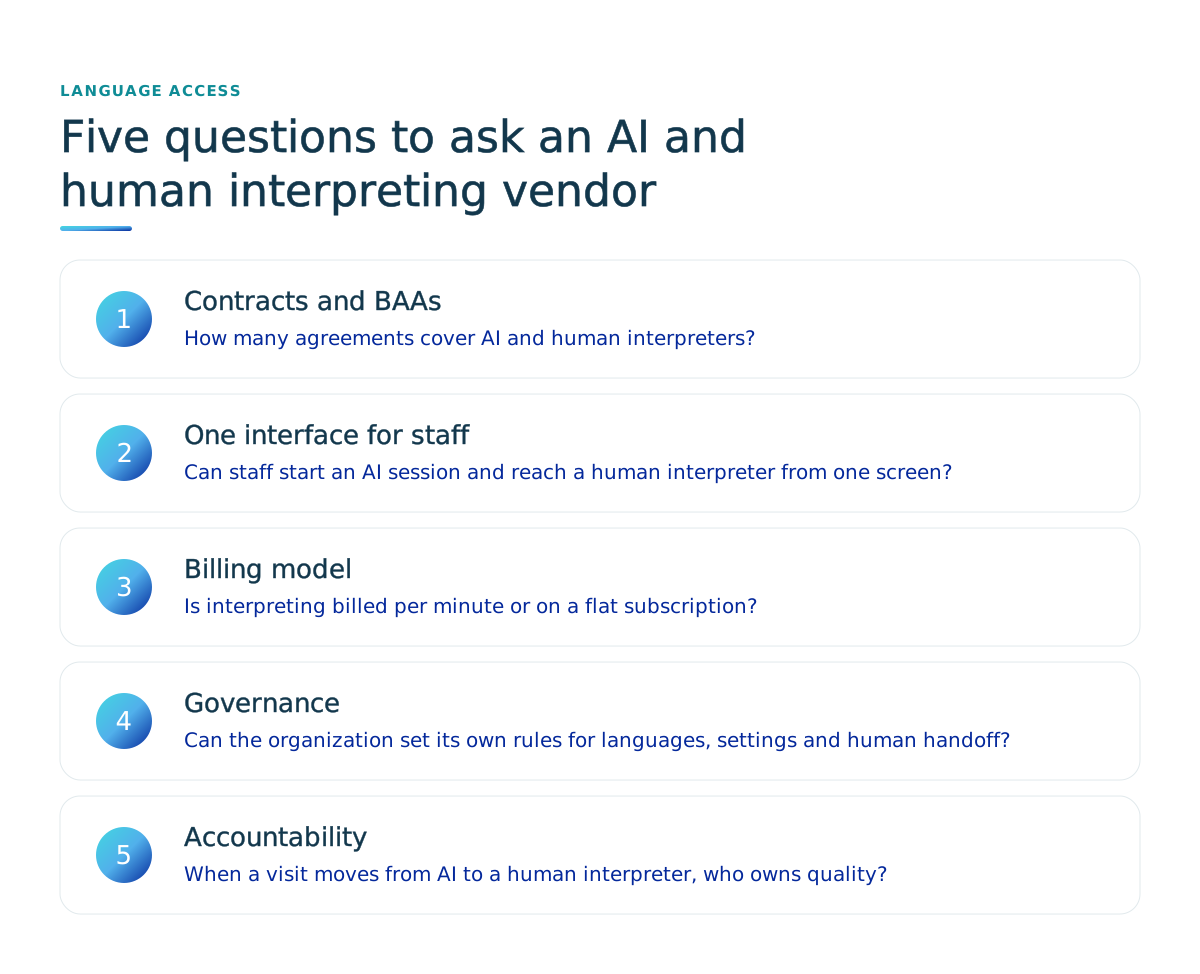
Five questions reveal how a vendor delivers AI by default and human on demand in practice. They apply to every vendor, including No Barrier.
Contracts and BAAs
How many agreements will the organization sign to cover AI interpreting and human interpreters? Each contract and business associate agreement adds review time for legal, compliance and procurement teams. For health systems and FQHCs alike, one agreement for both modalities keeps procurement simple and renewal dates aligned.
One interface for staff
Do clinicians and front desk staff use the same screen to start an AI session and to reach a human interpreter? Every extra login or app adds steps during a busy shift. A single interface also keeps training short and makes adoption easier for new staff.
Billing model
Is interpreting billed per minute or on a flat subscription? Are AI interpreting and human interpreters billed under the same model or does each modality carry its own rates? Per-minute billing can put background pressure on how long providers spend with patients who need language support. A single, predictable subscription lets finance teams budget language access as a fixed line item, even as patient volume grows.
Governance
Can the organization set rules at its own level: which languages, which settings and when a human interpreter joins? Governance belongs to the health system. The vendor provides the tools and the reporting that make those rules visible.
Accountability when an encounter changes
Who owns interpreting quality across AI and human sessions? When AI interpreting and human interpreters come from different vendors, each one runs its own interpreting quality checks, reports and contract terms. Keeping interpreting quality consistent across both becomes harder to track. Third-party accountability is also split between providers. One vendor that stands behind both can apply one interpreting quality process and one line of accountability to every encounter.
AI and Human Interpreting: Five Questions to Ask Any Vendor
How does No Barrier deliver AI by default and human on demand?
No Barrier was built for this model from day one. AI interpreting and human interpreters work in the same platform, under one contract.
One platform from the start
No Barrier provides AI-first medical interpreting, with human interpreters on demand in the same platform. Care teams reach 295+ language access options from one screen. A provider starts with AI interpreting and brings in a human interpreter on demand, without opening another tool. The service runs 24/7, including night shifts, at every patient touchpoint: inpatient care, call centers, telehealth video and bilingual discharge letters.
Proven at scale
No Barrier is deployed across 300+ medical sites in 17 states, including 20+ FQHCs. Deployments span specialties from pediatrics to urology to oncology, in clinical and administrative settings. The same platform covers in-person encounters, phone interpreting in call centers and telehealth video. A flat monthly subscription replaces per-minute billing. Clients have reduced annual interpreting costs by 30% to 50%. For more on how leaders evaluate this model, see the questions healthcare leaders ask before committing to AI interpreting.
Built with health centers
No Barrier is HIPAA compliant and SOC 2 Type II certified and signs a BAA with every customer. A customer-level governance layer lets each organization set its own rules, with tools such as "Point your language" front desk signage. A dedicated Customer Success team supports every rollout. No Barrier was selected for the 2026 NACHC/ScaleHealth Accelerator Cohort.
Equiti's acquisition of Lexi confirms the direction of the market. AI by default and human on demand is now the standard for medical interpreting. The choice for health centers is whether to adopt it as one platform today or to wait for separate products to come together. Talk to the No Barrier team to see the model in practice.
FAQs
What does "AI by default and human on demand" mean in medical interpreting?
AI by default and human on demand is a medical interpreting model where AI interpreting covers approved use cases and a qualified human interpreter joins whenever the clinical context, the patient or the provider calls for one. Health systems and FQHCs use it to extend language access across every touchpoint. No Barrier delivers both on the same platform.
Why are language service companies acquiring AI interpreting startups?
Established language service companies are acquiring AI interpreting startups to meet demand at every touchpoint of care. AMN Healthcare acquired Jaide Health in June 2026 and Equiti acquired Lexi in October 2026. Both deals point to the same model: AI by default and human interpreters on demand. No Barrier has delivered this model in one platform from the start.
How does No Barrier combine AI and human medical interpreting?
No Barrier combines AI and human medical interpreting in one platform. A provider starts with AI-first medical interpreting and brings in a human interpreter on demand, if requested. No Barrier integrates with Epic and gives care teams 295+ language access options from one screen, 24/7, under one contract and a flat monthly subscription.
Which questions should health systems ask before choosing an AI and human interpreting vendor?
Health systems should ask five questions before choosing an AI and human interpreting vendor. How many contracts and BAAs are required? Do staff use one interface? Is billing per minute or flat for both modalities? Who sets governance rules? Does a human interpreter join the same session in the same platform? No Barrier answers with one vendor, one interface and one platform for both modalities.
Where has No Barrier deployed AI by default and humans on demand?
No Barrier is deployed across 300+ medical sites in 17 US states, including health systems and 20+ FQHCs. Deployments cover specialties from pediatrics to urology to oncology, in clinical and administrative settings. The platform supports in-person encounters, call centers and telehealth video. Clients have reduced annual interpreting costs by 30% to 50%.
Eyal Heldenberg
Co-founder and CEO, building No Barrier
Eyal has 20+ years in speech-to-speech and voice AI and is the co-founder of No Barrier AI, a HIPAA-compliant medical interpreter platform. Over the past two years, he has led its adoption across healthcare organizations, helping providers bridge dialect gaps, reduce compliance risk and improve patient safety. His mission is simple: ensure health equity by removing language barriers at the point of care.