Pre-Visit Language Access: Building Flow Before the Appointment
Pre-visit language access is an operational part of the patient journey. Learn how scheduling, intake, language-preference data and AI medical interpreting work together for patients with limited English proficiency.
A patient's language-access experience often begins before the patient meets a clinician. It may begin with a scheduling call, an appointment reminder, an intake form, a portal message or a request to confirm insurance information or language preference. When those steps work, the clinical encounter starts with better information and less friction. When they do not, language access is compromised.
That makes pre-visit language access a key focus for the healthcare organization. It is an operational and governance item in the patient journey. It affects flow, patient experience, staff workload, documentation and the organization's ability to provide meaningful access for people with limited English proficiency (LEP).
TLDR: What is pre-visit language access?
Pre-visit language access is the set of workflows that helps patients with limited English proficiency communicate with a healthcare organization before the clinical encounter begins. It includes scheduling, registration, intake, reminders, forms, portal messages, address instructions, insurance communication and the handoff of language-preference information into the clinical workflow.
The practical answer is straightforward: organizations have to identify a patient's preferred spoken and written language at the first meaningful point of contact, record that information in a structured way, provide appropriate interpreting or translation at each pre-visit step and make the information visible to the teams that will use it. AI medical interpreting is key because it can provide immediate, scalable spoken-language support at the point where staff and patients are trying to move the visit forward, while still fitting inside a governed program.
A useful pre-visit language-access program should do five things:
Identify language needs at the first meaningful point of contact.
Record preferred spoken and written languages in the EHR or scheduling system.
Route each interaction to the right modality, such as translated documents, telephone interpreting, video interpreting, human interpreting and/or AI medical interpreting.
Carry language information forward across the patient journey instead of rediscovering it at every visit.
Measure whether the workflow improves access, flow, patient experience and safety.
Why language access begins before the visit
A patient may encounter several language-dependent steps before seeing a clinician. The sequence is familiar: call to schedule, confirm demographics, describe the reason for the visit, receive instructions, complete forms, arrange transportation (listen to the Care Culture Talks podcast about transportation instructions with Dr. James Richardson) and arrive prepared for the appointment. Each step can either reduce uncertainty or add another point of complexity.
For patients with LEP, a missed connection at scheduling may become a delayed appointment. An English-only intake form may produce an incomplete history. A reminder sent in a language the patient cannot read may contribute to a no-show. A portal message that is not understood may create another phone call, another queue and another burden on front-desk staff.
This is why pre-visit language barriers can be considered as flow issues. They influence how quickly the patient reaches the right service, how much time staff spend correcting information and whether clinicians begin the encounter with the context they need.
The case for language access is already well established
Research and public-health reporting have consistently described language barriers as connected to patient-safety and access concerns. A Pennsylvania review of 336 patient-safety events, for example, linked language barriers with errors involving consent, medication instructions and discharge communication. Federal data puts the number of people in the United States with limited English proficiency at 29.6 million (GSA, Translation and Interpretation Services SIN 541930 Ordering Guide, December 2025), and many patients do not consistently receive care in their preferred language.
The point is not that every pre-visit language problem produces a clinical error. The point is that the pre-visit workflow shapes the conditions under which the clinical encounter begins.
What does Title VI and Section 1557 require for language access?
Title VI of the Civil Rights Act prohibits discrimination based on national origin by programs that receive federal financial assistance. Federal guidance has long treated language access for people with limited English proficiency as part of the responsibility to provide meaningful access.
Section 1557 of the Affordable Care Act adds a healthcare-specific civil-rights framework. Its language-access requirements apply to many health programs and activities that receive federal financial assistance. The practical implication for operations teams is that language access should be considered across the full patient journey, not only at the bedside.
The CLAS standards provide an additional planning framework for culturally and linguistically appropriate services. The National CLAS Standards address areas such as governance, communication, workforce capability and organizational accountability. They are useful because they connect language access to how an organization is managed, not merely to whether an interpreter can be found for one encounter.
These requirements and standards do not prescribe one universal technology stack. An organization still needs to determine which modalities fit its patient population, encounter types, available resources, clinical policies and risk controls. That is where governance matters when building a language access program.
Where do pre-visit language barriers occur?
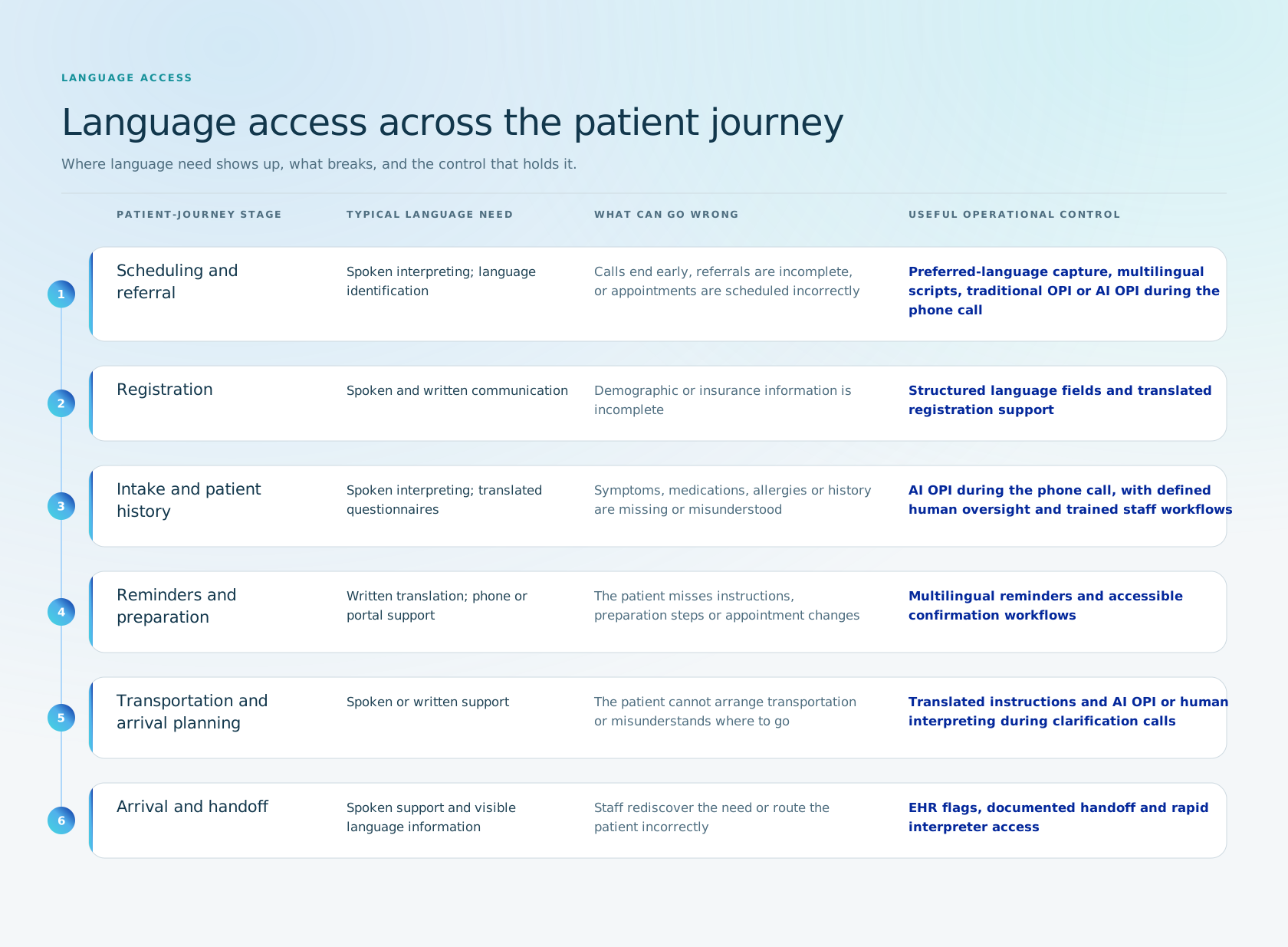
Pre-visit access is easier to manage when the organization maps the patient journey as a sequence of operational moments rather than as one general "language access" category. The table below shows why no single service solves every pre-visit need. Written translation is valuable for forms and reminders. Spoken interpreting is needed when a patient describes symptoms, asks questions or confirms instructions. AI medical interpreting is particularly useful when the need is immediate, conversational and distributed across many points of contact.
Language Access across the Patient Journey
How should a language access program identify patient preferences?
The first control is simple: ask the patient. Organizations should avoid inferring language preference from ethnicity, surname, nationality or the language a staff member assumes the patient speaks.
A registration or scheduling workflow can ask two separate questions: what language do you prefer using, and what language do you prefer for written information? Spoken and written preferences are not always the same, so they can be treated separately. The information should be captured in structured EHR or registration fields and accessible to every provider. Structured information can be displayed to the scheduling team, attached to the encounter, used to prepare documents and passed to clinical staff before the patient arrives.
A practical governance standard includes:
A defined owner for language-preference data.
A consistent script for asking and confirming preferences.
A process for updating preferences when the patient requests a change.
A visible indicator for spoken and written language needs.
A documented method for recording the interpreting modality and interpreter identity.
A way to record a patient's preference for a human interpreter or the need for human oversight.
The aim is not to add administrative work for its own sake. It is to prevent the same work from being repeated in multiple places by multiple people.
How do health systems provide medical interpreting today?
Many health systems already have a language-access program in place. The program is usually a practical combination of several resources rather than one universal service.
Bilingual receptionists and schedulers often support the first interaction with a patient. Bilingual staff may help with communication when the organization's policy allows it. Some organizations employ in-house qualified medical interpreters, particularly where the patient population and volume justify dedicated coverage. Many also have contracts with traditional language-access providers such as LanguageLine or similar services, which connect staff to interpreter call centers by telephone or video.
The workflow is familiar. A receptionist calls the patient, places the patient on hold, contacts the language-access provider, waits for an interpreter to become available and then merges the interpreter onto the line. The three participants begin the scheduling, intake or history discussion together. For a hospital managing a large volume of encounters, this model can provide broad language coverage and a clear process that staff already understand.
It also creates a dependency chain. The patient needs to answer the phone. The receptionist needs to identify the language and reach the call center. The call center needs to have an appropriate interpreter available. The audio connection needs to hold. The interpreter needs to remain on the line until the interaction is complete. If any link fails, the pre-visit workflow slows down or stops.
What are the limits of the traditional language-access model during pre-visit?
Traditional interpreting services continue to play an important role during pre-visit, but their operating model can be difficult to scale across every scheduling call, intake interaction and patient-history exchange.
Time, availability and connection
The first constraint is often time. Staff may wait in a queue before an interpreter answers. The wait may be especially noticeable for less common languages, dialects, evenings, weekends or periods of high demand. A short scheduling question can become a longer operational event because the organization must establish the connection before the conversation can begin.
The second constraint is availability and fit. A vendor may cover a language but not have the right dialect or an interpreter available at the moment the patient calls. For a higher-risk clinical interaction, the question is not only whether someone speaks the language. The organization may also need to confirm qualifications, specialty experience, confidentiality expectations and the correct modality under its own policy.
The third constraint is connection quality. Audio may be difficult to hear, the call is routed through several systems or the parties are speaking from a busy reception area. Calls can drop, participants may need to repeat information and staff may have to restart the connection. These are not minor inconveniences when the conversation involves a medication list, symptoms, referral details or preparation instructions.
Workflow and infrastructure
There is also a workflow and infrastructure constraint. Some organizations are working with aging telephones, shared devices, separate vendor portals or call-center technology that was designed for voice access but not for integrated digital healthcare workflows.
These limitations do not mean that traditional language-access services are unsuitable. They explain why many health systems are looking for a broader operating model: one that retains qualified human interpreting where it is most important while adding faster, more accurate and more integrated options for distributed language needs.
How can AI medical interpreting upgrade a language-access program?
Health systems that are reviewing their language-access operations are increasingly introducing AI medical interpreting as an additional layer. The objective is not to remove human interpreters from the program. It is to improve the infrastructure around access: faster connection, clearer sound, wider practical availability and better integration with the patient journey.
At the pre-visit stage, the immediate benefit is reduced friction. An AI medical interpreter joins the call when a staff member needs to clarify an appointment, collect a history, confirm a preparation step or resolve a question before the visit. Instead of making every short interaction depend on a call-center queue, the organization can provide an on-demand option for appropriate use cases.
Improving communication and workflow
The technology itself also improves sound and participation. Modern AI-enabled systems are designed for real-time conversational exchange. When the interaction is easier to hear and the participants do not have to repeatedly reconnect, the patient, receptionist, scheduler and clinical team can keep the workflow moving.
A tiered model for language access
The strongest model is therefore tiered. Bilingual staff continue to serve appropriate functions when they meet the organization's qualification and policy requirements. In-house qualified interpreters remain available for encounters that call for their expertise. AI medical interpreting, through OPI, adds an immediate option for complex, high-volume and distributed interactions, with human oversight available in the same workflow.
For operations and governance leaders, the relevant questions are practical:
Where do interpreter queues create the most delay in scheduling, intake and patient-history workflows?
Which languages and dialects account for the highest volume or the largest coverage gaps?
How often do staff experience dropped calls, poor audio or repeated connections?
Which encounters can use an AI-first workflow, and which must route directly to a qualified human interpreter?
Can the organization document the modality, language and outcome of each interaction?
Does the technology fit the telehealth, privacy, security and language-access policies already in place?
How can pre-visit language access improve patient experience?
Patient experience is affected by whether the organization feels navigable. A patient who can schedule an appointment, understand what to bring, complete intake and ask a question without repeatedly explaining a language need encounters less friction before the visit even begins.
That experience also affects trust. When a preferred language is captured and respected consistently, the patient sees continuity across the organization. When each department asks the same question from the beginning, the patient may experience the system as fragmented, even when every individual employee is trying to help.
The operational lesson is that patient experience does not require a separate language-access track. It can be measured inside ordinary flow metrics:
Time from first contact to scheduled appointment.
Abandoned or dropped scheduling calls by preferred language.
No-show and rescheduling rates by language.
Intake completion rates.
Time spent connecting interpreting.
Number of repeated language-preference questions.
Patient-reported understanding of preparation and follow-up instructions.
Transitions from AI medical interpreting to a human interpreter.
These measures help a governance team see where the system is working and where a policy, training, technology or staffing change may be needed.
What should an organization include in its pre-visit governance model?
A language access program becomes more reliable when ownership is explicit. The organization should define who maintains the policy, who monitors performance, who approves the human-oversight rules, who reviews incidents and who is responsible for keeping translated content current.
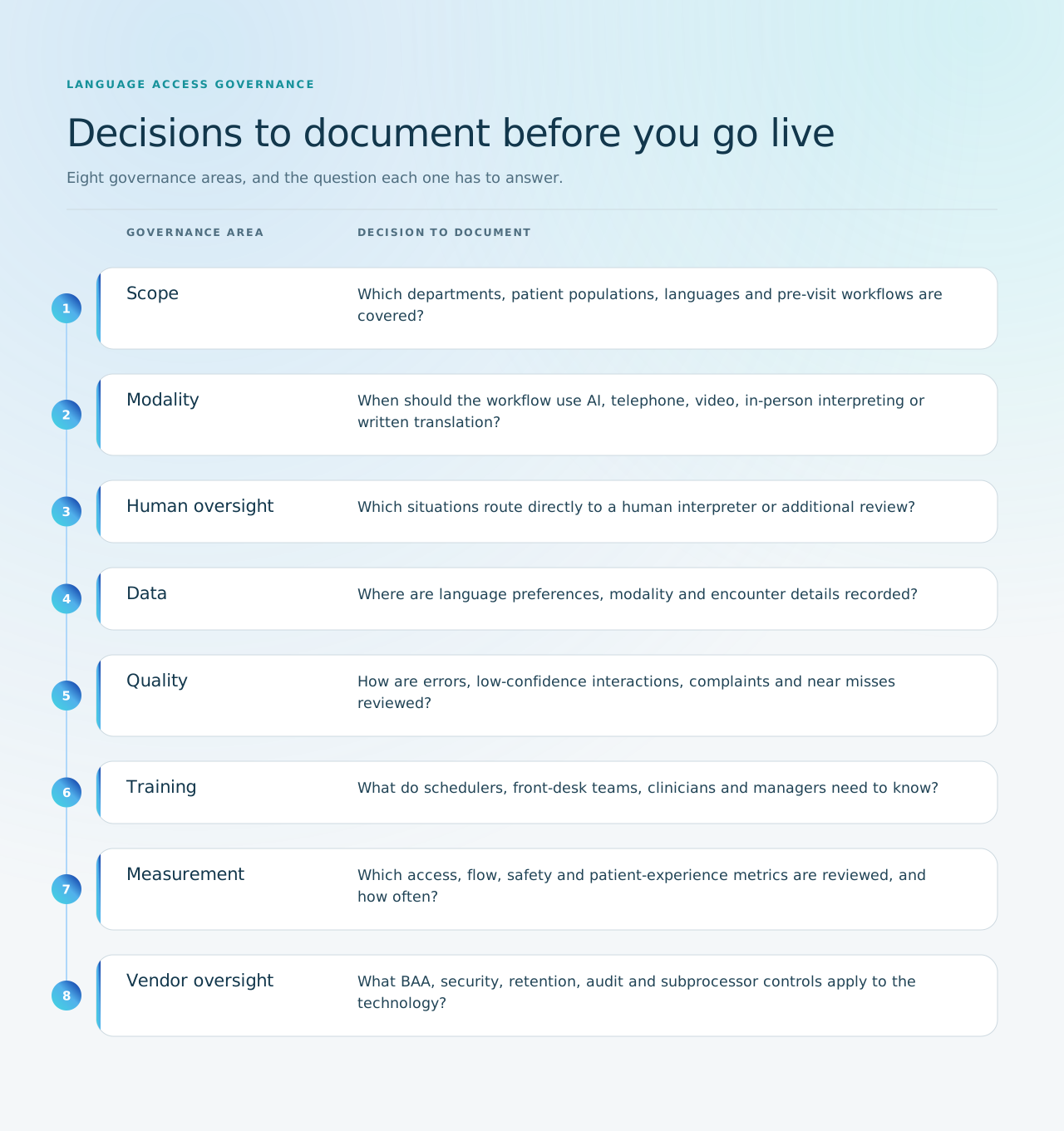
A practical governance model can include the following components:
Eight Governance Areas
Final thoughts: language access is part of patient flow
The pre-visit period is where healthcare organizations collect information, make decisions and establish the conditions for a successful encounter. It is also where language needs can be identified early enough to improve the rest of the patient journey.
A well-designed language access program does not ask staff to improvise every time a patient needs help. It gives them a visible language-preference signal, a clear routing path, appropriate technology, human oversight and a way to measure what happens next.
AI medical interpreting is key in this model because it can make language support available at the speed of operations: during scheduling, intake, patient history and the many short interactions that connect a patient to care. Its role is not to replace governance or qualified human support. Its role is to help the organization build a language-access workflow that starts before the appointment and continues through the full patient journey.
What is OPI and how does AI OPI support pre-visit language access?
OPI stands for over-the-phone interpreting, the spoken-language support delivered when a staff member and a patient are on a call. AI OPI applies the same modality with an AI medical interpreter that joins on demand, without a call-center queue. No Barrier delivers AI OPI so schedulers and intake teams can instantly clarify an appointment, collect a history or confirm a preparation step at the speed of the phone call.
When does language access begin in the patient journey?
It begins before the clinical encounter. A patient's first language-dependent moments are usually scheduling, registration, intake, reminders and transportation or arrival planning. Capturing preferred spoken and written language at the first meaningful point of contact, then carrying it forward, keeps each later step from restarting the same conversation.
What belongs in a pre-visit language access governance model?
A workable model names an owner for language-preference data, defines modality routing, sets the rules for routing to a human interpreter and specifies where language and interaction details are recorded, then schedules quality and measurement reviews. Vendor oversight matters too. No Barrier is HIPAA and SOC 2 Type II certified, which gives governance teams the BAA, security and audit footing they need before a technology touches patient interactions.
Can a language access program audit interpreting at the utterance level?
Utterance-level audit means being able to review the individual spoken exchanges in an interaction, the language, the modality and the outcome, rather than only a call-length record. That lets a governance team review what was communicated, not just that a call took place.
Moe Abramovitch
Co-founder and COO, building No Barrier
Moe is a senior technology leader with a strong background in software development and operations. He specializes in bridging advanced AI with real-world healthcare workflows, ensuring technology fits into clinical environments. Beyond operations, Moe documents his journey and shares practical tips with healthcare leaders, offering guidance on AI adoption, organizational change and operational excellence.









.svg)